
3LPE coating is a three layer external anti-corrosion system for steel pipe. The 3LPE coating full form is three layer polyethylene, and the name describes the build: a fusion bonded epoxy primer against the steel, a copolymer adhesive over it, and a polyethylene jacket on the outside. The epoxy layer carries the corrosion protection. Polyethylene carries the mechanical protection, absorbing impact during loading, shear as the pipe goes into trench, and abrasion from backfill against stone. Coated pipe is then buried or submerged and left to work for decades with limited maintenance access.
Radisson Impex applies 3LPE coating to steel pipe in India, and we can also supply pipe with the coating already applied. We have held ISO 9001 certification since the company started in 2012. Our scope covers seamless, ERW, LSAW and spiral welded pipe in mild steel, LTCS and alloy steel, from 1 inch to 120 inch outside diameter, up to 18 metres long and 24 tonnes per pipe. We coat fittings, bends and flanges alongside straight lengths, and we clean and re-coat old, used or rusted pipe that has already been in service. Surface preparation is by abrasive shot blasting to Sa 2½, coating thickness follows your project specification, and test certificates are issued with every job. EPC contractors and government tender projects across India make up most of our work.
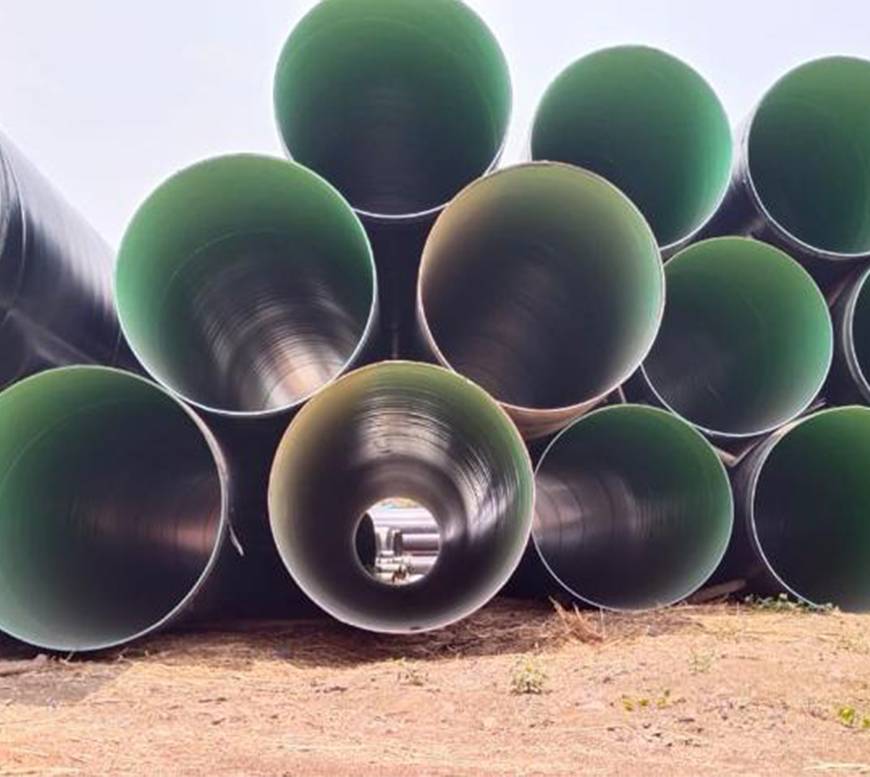
3LPE Coating Service Options
Applied at our Vasai factory or at your project site, pan-India. Three service options to suit your pipe coating requirements.
-
At our facility
Factory Coating
Pipe coating on our extrusion line at Vasai, with transport arranged for your pipes in both directions.
- Vasai factory
- Pipe transport arranged
-
At your project site
Onsite Coating
Crew, blasting equipment and materials travel to your location, so pipe never leaves the project. Available across India.
- Pan India
- Coated at your project site
-
For existing pipes
Re-Coating
Failed coating is stripped, the substrate blasted back to bare steel, and the three-layer build applied again from scratch.
- Old, used or rusted pipe
- Stripped, blasted, recoated
The 3LPE Coating System: Three Layers Explained
The 3LPE coating system is built from three bonded layers, and each one is useful in its own way. Layer 1 is a fusion bonded epoxy (FBE) primer carrying the corrosion protection, layer 2 a copolymer adhesive, and layer 3 an extruded polyethylene jacket carrying the mechanical protection.

-
Layer 1 : Fusion Bonded Epoxy (FBE) Primer
Fusion bonded epoxy is applied as a powder onto pre-heated steel, where it melts and cures into a thermoset film bonded to the blasted surface. This layer does the anti-corrosion work. Everything above it protects the epoxy. The same chemistry underpins our wider range of epoxy coating work, and we use FBE materials from brands including 3M Scotchkote and Jotun.
-
Layer 2 : Copolymer Adhesive
The middle layer is a copolymer adhesive, usually a maleic anhydride grafted grade, and it ties the epoxy below to the polyethylene above. Without it, the two polymers separate under thermal cycling and soil stress. Adhesion failure between layers is what shortens coating life on a badly built system.
-
Layer 3 : Polyethylene Topcoat
Medium to high density polyethylene forms the outer jacket, extruded over the adhesive while the pipe is still hot. Impact during loading, shear as the pipe goes into trench, abrasion from backfill: the jacket handles all of it. It keeps water off the epoxy too. That's why 3PE systems last in submerged ground where a thin single film would not.
3 Layer Polyethylene Coating Specifications
The 3LPE coating specification below sets the scope boundaries of what we coat and supply, within our wider external pipe coating range. Raise anything outside these figures at enquiry stage.
| Parameter | Scope |
|---|---|
| Coating system | Layer 1 fusion bonded epoxy primer, Layer 2 copolymer adhesive, Layer 3 polyethylene topcoat |
| Pipe types accepted | Seamless, ERW, LSAW, spiral welded (HSAW) |
| Substrates accepted | Mild steel (MS black), LTCS, alloy steel |
| Line pipe | API 5L line pipe, Grade B through X80 |
| Components coated | Straight pipe, fittings, bends, flanges |
| Substrate condition | New pipe, plus cleaning and re-coating of old, used or rusted pipe |
| Outside diameter range | 1 inch to 120 inch |
| Maximum pipe length | 18 metres |
| Maximum weight per pipe | 24 tonnes |
| Surface preparation | Abrasive shot blasting to Sa 2½ |
| Coating thickness | Applied to the thickness stated in the customer specification |
| Documentation | Test certificates and coating reports supplied with the job |
3LPE Coating Standards
The 3LPE coating standard your project names governs surface preparation, thickness and the test regime, and we execute to that document. ISO 21809-1 is the international reference, IS 15659 (Part 1) is its Indian adoption, and the table lists the designation used in each major market.
- International (ISO)
- ISO 21809-1:2018Petroleum and natural gas industries. External coatings for buried or submerged pipelines used in pipeline transportation systems. Part 1: Polyolefin coatings (3-layer PE and 3-layer PP)
- India (IS)
- IS 15659 (Part 1) : 2006Petroleum and natural gas industries. External coatings for buried or submerged pipelines used in pipeline transportation of gas and liquid hydrocarbons. Part 1: Polyolefin coatings (3 layer PE and 3 layer PP)
- Germany (DIN)
- DIN 30670-1:2024 and DIN 30670-2:2024Polyethylene coatings of steel pipes and fittings. Part 1 factory-applied extruded coatings, Part 2 factory-applied sintered or flame-sprayed coatings. These replaced DIN 30670:2012
- Japan (JIS)
- JIS G 3477-1:2022Polyethylene coated steel pipes. Part 1: external 3-layer extruded polyethylene coated steel pipes
- Canada (CSA)
- CSA Z245.21, in CSA Z245.20 Series:22Plant-applied external polyethylene coating for steel pipe
- China (GB/T)
- GB/T 23257Polyethylene coating for buried steel pipeline
- Russia (GOST)
- GOST R 51164-98Steel main pipelines: general requirements for corrosion protection
Those designations are the reference framework for Three Layer Polyolefin coating internationally. Send the 3LPE coating specification your tender is written to, and we will confirm scope and test requirements before quoting.
Features and Benefits of 3LPE Coating
Six properties explain why 3LPE remains the default choice for buried steel pipelines, and each one reaches the project as either cost or risk.
-
Two protective mechanisms in a single system
Corrosion protection and mechanical protection arrive together rather than as a trade-off between them. A single film coating makes you choose; the three layer build does not.
-
Damage tolerance during construction
A large share of coating damage happens during handling, not in service. Stringing, lowering-in and backfill against stone are where thin coatings get cut, and the polyethylene jacket absorbs that handling, so fewer holidays reach the trench and less field repair time is booked.
-
Lower cathodic protection demand
Resistance to cathodic disbondment and low water uptake keep the current draw on your CP system down across the life of the line. That's an operating cost, not just a coating property.
-
A service envelope covering most onshore duty
Continuous service up to around 80 °C takes in the great majority of buried oil, gas and water pipelines.
-
Tender-recognised worldwide
ISO 21809-1, DIN 30670-1 and IS 15659 (Part 1) all cover the same three-layer system, so specifying it needs no bespoke qualification case, and inspection criteria are already written.
-
Repairable before it goes in the ground
Where holiday detection finds a discontinuity, that spot is repaired and re-tested rather than the whole length being rejected.
3LPE Coating Process
The 3LPE coating process runs in sequence: shot blasting, pre-heating, FBE powder application, adhesive and polyethylene layers, then cooling, inspection and repair of any holidays. Straight lengths run through our extrusion line. Fittings, bends and flanges are coated on a separate manual station, so complex shapes take the same three-layer build as straight pipe.
-
Surface Preparation
Abrasive shot blasting takes the substrate to Sa 2½, the near-white metal grade polyolefin systems call for. Mill scale, rust and previous coating come off, and the blast profile gives the epoxy something to key into. Poor preparation is the commonest cause of early adhesion failure. We check the blasted surface before any powder goes on.
-
Coating Application
The blasted, pre-heated pipe receives FBE powder electrostatically, and the powder melts onto the hot steel. Copolymer adhesive follows while the epoxy is still gelled. The polyethylene jacket then goes over the top, and timing across the three layers is what produces a bonded system rather than three separate films.
-
Inspection and Handover
We check every coated length before it leaves our control. Dry film thickness, holiday detection, adhesion and curing results are recorded against the job, and any holiday found is repaired and re-tested. The documentation package travels with the pipe. That is the whole 3LPE pipe coating process, from bare steel to a documented, coated length ready for despatch.
3LPE Coating Thickness and Performance
3LPE coating thickness is set by your project specification rather than a fixed house standard, and we coat to the figure your document states. Temperature limits and resistance behaviour follow from the build itself.
Layer Thickness Ranges
Your specification sets thickness per layer and as a total, drawing on the standard your project works to. We don't publish one company-wide dry film thickness range, because imposing our figure over your specification would put the coating out of compliance. Send the document and we will confirm both at quotation stage.
Operating Temperature Range
Continuous service up to around 80 °C is the ceiling most project specifications quote for three layer polyethylene, and the lower limit runs to about -40 °C. Coating classes differ, so a lower ceiling can apply to the grade your specification names.
Send Us Your 3LPE Coating Schedule for a Coating Quote
ISO 9001 certified coating operations, running from Mumbai since 2012 with pan-India execution. Factory photos, video of live application and a sample test certificate are available on request.
3LPE Coating Testing and Inspection
Coating quality is confirmed by measurement and documented records. Four checks run on every job, and they are also the checks that catch the 3LPE coating defects most likely to reach site:
-
Dry film thickness (DFT)
We take readings across the coated surface and compare them against the thickness your specification states.
-
Holiday or spark testing
An electrical test locates pinholes and discontinuities in the film. Anything found is repaired and re-tested before release.
-
Adhesion or pull-off testing
We measure bond strength to the steel and between layers, since that property decides how the coating behaves in the trench.
-
Curing testing
We verify cure state, so the epoxy has developed its designed properties before the pipe moves.
Third-party inspection agencies are accommodated where your contract calls for witnessed testing or a resident inspector. Test certificates and coating reports go out with the job. That documentation is what procurement actually awards a coating package on.
3LPE Coating Industrial Applications
3LPE anti-corrosion coating goes onto buried and submerged steel pipelines carrying oil, natural gas, drinking water and industrial fluids, and onto the bends and fittings installed with them. Four groups account for most of the polyethylene coated steel pipe we handle.

Oil and Gas Pipelines
Cross-country crude and natural gas lines are the original and largest 3LPE application. Access is limited once buried, so the coating must survive installation and last decades. City gas networks use it at smaller diameters.

Water Transmission and Distribution Pipelines
Water utilities and irrigation schemes run large diameter steel mains through soils that change along the route. External three layer coating protects the pipe wall while the line stays buried.
Chemical and Process Plant Piping
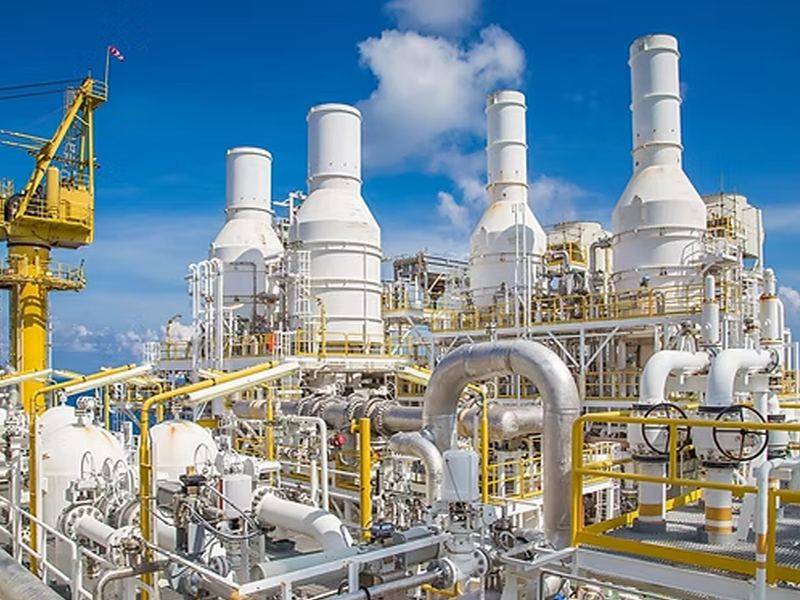
Buried process lines and fire-fighting mains inside plant boundaries face the same corrosion exposure as cross-country pipe, with congested routing and more fittings per metre. Coated bends matter more here than on a straight run.
Buried and Submerged Pipeline Sections
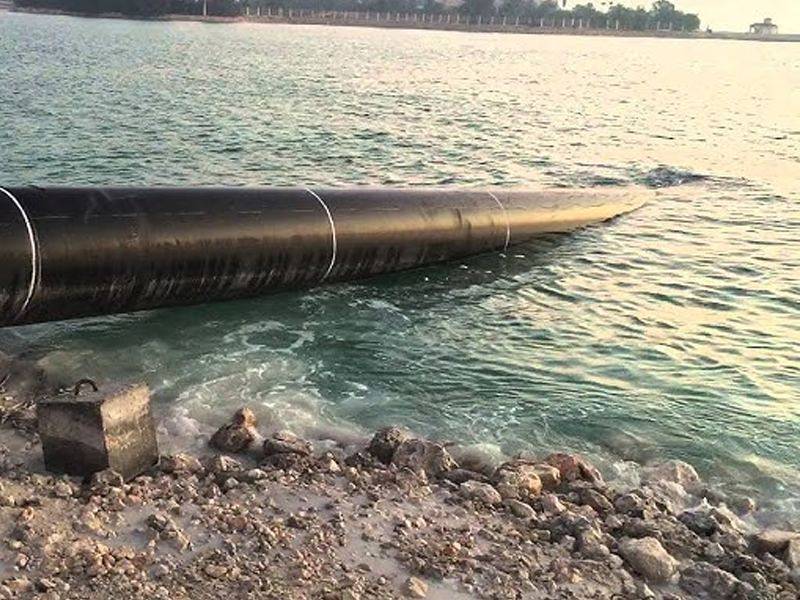
River crossings, marine approaches and any section below the water table sit in the environment this system was developed for. Continuous water contact is where a single film is most likely to fail.
3LPE vs 3LPP vs FBE: Choosing the Right Coating
Choose 3LPE for buried and submerged pipelines operating up to roughly 80 °C where cost matters. Choose 3LPP for higher operating temperatures. Choose standalone fusion bonded epoxy coating where a thin single layer epoxy is specified and mechanical protection is less critical. We apply all three, so the table is selection guidance rather than a sales position.
3LPE
- Build
- FBE, copolymer adhesive, polyethylene
- Typical service ceiling
- Around 80 °C
- Mechanical protection
- High
- Relative cost
- Lower
- Common use
- Buried and submerged pipelines
3LPP
- Build
- FBE, copolymer adhesive, polypropylene
- Typical service ceiling
- Around 110 °C
- Mechanical protection
- Highest
- Relative cost
- Higher
- Common use
- High temperature lines
FBE (single layer)
- Build
- Epoxy film only
- Typical service ceiling
- Set by the epoxy grade specified
- Mechanical protection
- Limited
- Relative cost
- Lowest
- Common use
- Where a single epoxy film is specified
The difference between 3LPP and 3LPE coating comes down to the topcoat polymer and the adhesive matched to it.
3LPE Coating Cost
Coating work is charged per square metre, against a minimum order of 200 square metres. There is no single rate, because the same metre of pipe costs differently depending on what it is and how it is specified. These are the factors that move the number on a quotation:
- Pipe outside diameter and total coated length
- Coating thickness and standard called for by your specification
- Substrate condition, since re-coating rusted pipe carries more preparation than new pipe
- Component mix, as bends and flanges take more handling per square metre than straight lengths
- Whether you are sending us pipe to coat or buying pipe with the coating applied
Get the best price for your project tonnage. Larger scopes price better per square metre, so send the full schedule rather than a single line item.

Why Choose Radisson Impex for 3LPE Coating
Here are five reasons to place your 3LPE coating in India with us, and the same team runs the rest of our pipe coating services.
- Coating and supply sit under one contract, so you can send us pipe or buy it coated.
- Fittings, bends and flanges take the same three-layer build as straight pipe, because manual application is not constrained by a fixed line profile.
- Old, rusted pipe can be cleaned back to bare steel and re-coated, keeping sound material in service.
- Thickness, surface preparation grade and test regime follow your project document rather than a house standard we ask you to accept.
- DFT, holiday, adhesion and curing results are issued as certificates and coating reports, with third-party inspection accommodated on request.
3LPE Coating: Frequently Asked Questions
What is 3LPE Coating and what does 3LPE stand for?
3 LPE stands for three layer polyethylene: a fusion bonded epoxy primer, a copolymer adhesive and an outer polyethylene jacket, applied to the external surface of steel pipe. We apply it in Mumbai and supply coated pipe from there.
What is the difference between 3LPE Coating and FBE Coating?
Single layer FBE gives you one thermoset epoxy film bonded to the steel. A 3-LPE build adds adhesive and a polyethylene jacket over that film. Mechanical protection, water resistance and abrasion resistance come with it.
What is the difference between 3LPP and 3LPE Coating?
Both share the same epoxy primer and a copolymer adhesive, and the topcoat polymer is what changes, with the adhesive grade matched to it. Polypropylene holds a higher service temperature than polyethylene and costs more, so 3LPP is chosen on temperature rather than by default.
What is the maximum temperature that 3LPE Coating can withstand?
Around 80 °C is the ceiling most specifications quote for continuous service. Coating classes differ and some grades are rated lower, so check the figure in your own document. Above that ceiling, 3LPP is the correct selection.
What is the density of 3LPE Coating?
The outer jacket uses a medium to high density polyethylene. We don't publish a fixed 3LPE coating density figure. The polymer grade is set by the coating specification your project names.
What 3LPE Coating thickness do you apply?
Thickness follows your project specification rather than a company standard. Send us the document and we will come back with per layer and total figures at quotation, then verify the applied build with dry film thickness readings.
Can you supply pipe with 3LPE Coating already applied?
Yes. We stock and supply pipe with the coating applied, and we also coat pipe that customers already own. Tell us which route suits your project and we will quote it that way.
Which 3LPE Coating standard do you work to?
ISO 21809-1, DIN 30670-1 and IS 15659 (Part 1) are the principal designations for this system. We execute to whichever specification your project is written to, so send that document with your enquiry.
Can you re-coat old or previously coated pipe?
Yes. Cleaning and re-coating of old, used or rusted pipe is an established part of our work: the existing coating is stripped, the substrate blasted back to Sa 2½, and the system rebuilt.