
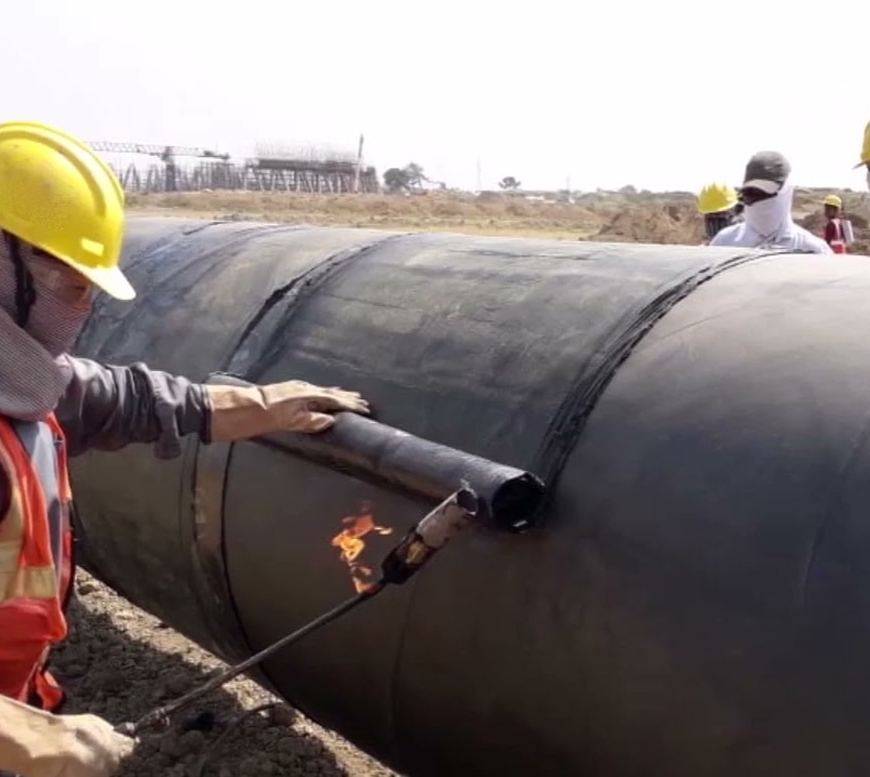
Coal tar tape coating is an external anti-corrosion wrap for steel pipe, and the name describes both the coating material and the application method. Coal tar enamel is held on a high-tensile glass fibre fabric. For hot-applied tape, the roll’s compound face is warmed with a torch, and the tape is wrapped onto a primed pipe surface under tension with a set overlap, without extrusion or spraying. The enamel forms the barrier that keeps soil moisture away from the steel, while the fabric holds that barrier together as the tape stretches around the pipe and as the pipeline is installed and subjected to soil movement in service.
Coal tar tape has held its place on buried pipelines because it does more than keep moisture out. Coal tar provides resistance to biological degradation in soil. The plant roots do not penetrate it the way they work through softer bituminous films. Coal tar pipe wrap has been used on buried water pipelines for decades, and IS 15337 specifies coal tar based anticorrosion tape for underground mild steel pipelines.
Radisson Impex wraps steel pipe with coal tar tape coating for projects across India. Our company was established in Mumbai in 2012 and holds ISO 9001 certification. Base materials covered are LTCS, alloy steel and mild steel (MS black). We wrap API 5L line pipe from Grade B up to X120. Across all pipe types, we handle outside diameters from 1 inch to 200 inches. We wrap full pipe lengths along with bends, fittings and flanges included in the same pipeline scope. We blast to Sa 2½ before priming tape thickness and overlap follow your project specification, and test certificates travel out with every job. Our coatings are most commonly specified for government tender projects and EPC contracts, which account for much of our order book.
Coal Tar Tape Coating Service Options
Wrapped at our Vasai factory or at your project site, pan-India.
-
At your project site
Onsite wrapping
- Pan India
- Wrapped at your project site
-
At our facility
Factory wrapping
- Vasai factory
- Pipe transport arranged
The Coal Tar Tape System
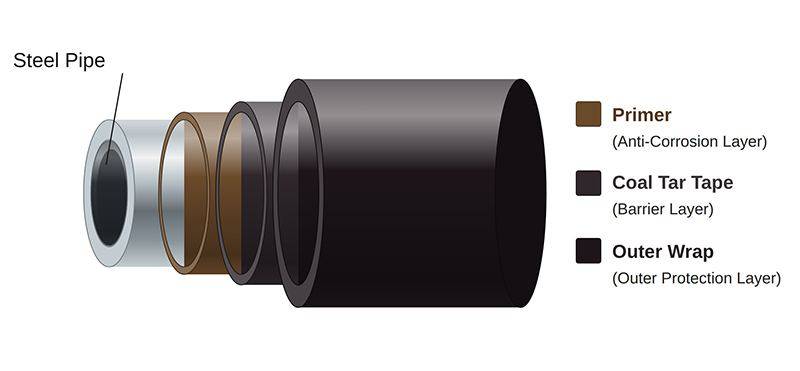
Three parts make up a coal tar tape system, and a specification names all three: the primer that wets the blasted steel, the enamel carrying the corrosion barrier, and the fabric that lets the enamel be wound onto a pipe. Each section is described below.
-
Coal Tar Enamel and the Glass Fibre Carrier
Coal tar enamel is a hot-applied coal tar pitch compound blended with mineral filler, and it contains no asphalt (bitumen). The glass fibre carrier provides tensile reinforcement during handling, winding and application. While the coal tar enamel forms the primary moisture barrier. Coating the fabric fully on both sides with coal tar produces what IS 15337 calls an anti corrosion coal tar tape, and a film separator keeps the layers of the roll apart until it is removed for wrapping. Most products on the Indian market is a hot applied coal tar tape. The applicable specification should define the required tape type and application method.
-
The Primer Coat
Primer goes onto the blasted steel first, before any tape comes in contact with the pipe. Its job is wetting: a solvent borne chlorinated rubber synthetic primer, containing a small amount of coal tar pitch, soaks into the blast profile and gives the enamel something compatible to bond against. The primer provides the compatible bonding layer between the prepared steel surface and the coal tar tape system. Primer is matched to the tape rather than chosen independently, and we specify the two together and apply them under one scope.
Why Coal Tar Suits Buried Ground
Coal tar tape remains applicable to selected buried pipeline systems where its specified properties meet the service requirements. Buried coatings are exposed to moisture, salts, biological activity and mechanical stresses associated with the surrounding soil. Soil bacteria degrade many organic coatings over a design life measured in decades, and coal tar resists that biological attack well. Roots are the second problem, and coal tar repels root growth rather than inviting it, which matters along canal banks and any route through cultivated land. Soil conditions also affect the loads and chemical exposure acting on a buried pipeline. Clay can swell and shrink with changes in moisture content, while accumulated salts from surrounding soil or agricultural activity can increase the corrosivity of groundwater.
Coal Tar Tape Specifications
The table summarises the coating system, accepted substrates, dimensional limits, application scope and documentation requirements. If the pipeline schedule falls outside these limits, include the details in the enquiry for technical review.
| Parameter | Scope |
|---|---|
| Coating system | Primer, then coal tar enamel tape on a glass fibre carrier, wound at a specified overlap |
| Application method | Tape warmed by torch (hot-applied tape) and wrapped under tension over a primed surface |
| Pipe types accepted | Seamless, ERW, LSAW, spiral welded (HSAW) |
| Substrates accepted | Mild steel (MS black), LTCS, alloy steel |
| Line pipe | API 5L line pipe is handled from Grade B up to X120 |
| Components wrapped | Straight lengths, plus bends, fittings and flanges on the same line |
| Substrate condition | New pipe |
| Outside diameter range | 1 inch to 200 inch |
| Maximum pipe length | 18 metres |
| Maximum weight per pipe | 24 tonnes |
| Surface preparation | Shot blasting to Sa 2½ |
| Tape thickness and overlap | Applied to the figures stated in the customer specification |
Coal Tar Tape Coating Standards
Coal tar systems carry their own designations, separate from the polyolefin and epoxy families, and whichever document your tender cites governs the work. The four references below cover coal tar coating systems. IS 15337 and ANSI/AWWA C203 cover coal tar tape directly. IS 10221 covers the hot-applied coal tar enamel and glass fibre wrap system, and BS 4164 covers hot-applied coal tar enamel materials and primer.
- India (IS)
- IS 15337 : 2003Coal tar based anticorrosion tape for protection of underground mild steel pipelines: Specification. Written by the Corrosion Protection and Finishes Sectional Committee, MTD 24, with one amendment on record. The only Indian Standard devoted to the tape itself
- India (IS)
- IS 10221 : 2008First revision, and the current edition. Covers application of the hot-applied coal tar enamel and glass fibre wrap system, holiday inspection and measurement. Material requirements are referred to IS 9912, IS 14695 and IS 15337
- USA (AWWA)
- ANSI/AWWA C203 : 2025Coal-Tar Protective Coatings and Linings for Steel Water Pipe and Fittings. Supersedes AWWA C203-20, which was titled Coal-Tar Protective Coatings and Linings for Steel Water Pipe. The American document covers coal-tar enamel and coal-tar tape together, hot applied, for buried steel water pipe
- UK (BS)
- BS 4164 : 2002Specification for coal-tar based hot-applied coating materials for protecting iron and steel, including a suitable primer. Withdrawn by BSI, though Indian and Gulf tender documents still call up its enamel grades 105/8 and 120/5
The ISO 21809 series has no part dedicated to coal tar coatings. Part 3 covers field joint systems, including hot-applied bituminous tapes, so check which part a tender names before selecting the coating.
Features and Benefits of Coal Tar Tape
Five properties keep coal tar tape in Indian pipeline specifications, and each of them reaches a project as either cost, schedule or long term risk.
-
Resistance to biological attack in soil. Biological degradation is one factor that can affect the long-term performance of buried organic coatings. Coal tar enamel holds up against it across the design life a water transmission main is built for.
-
Root repellency along cultivated routes. A line crossing farmland or canal banks meets root pressure that a soft bituminous film invites. Coal tar does not encourage that growth, so the barrier stays intact where the route is greenest.
-
Conforms to pipe and fitting geometry. Tape conforms to bends, reducers and flange backs, so a fitting takes the same system as the barrel next to it.
-
Local repair instead of rejection. Where inspection picks up a lifted edge or a void, that spot is re-wrapped and re-checked, and the length is not condemned over a defect a few centimetres across.
-
A specification framework that already exists. IS 15337 is published and familiar to Indian consultants, and it gives projects a clear specification for coal tar tape. IS 10221 sits alongside it for the hot-applied enamel system.
Coal Tar Tape Wrapping Process
The coal tar wrapping coating procedure consists of three steps: blasting, priming, warming & winding the tape at the specified overlap and tension, and then inspection before release. A 1,000 mm barrel and a bend off the same line take that identical sequence.
-
Surface Preparation
Our blasting grade is Sa 2½, reached with abrasive shot, and the whole workflow is built around it. Mill scale, rust and any old coating are removed, and the profile that survives is what the primer keys into. Preparation is checked before priming starts, since that is the last moment anyone can see the steel.
-
Priming and Tape Application
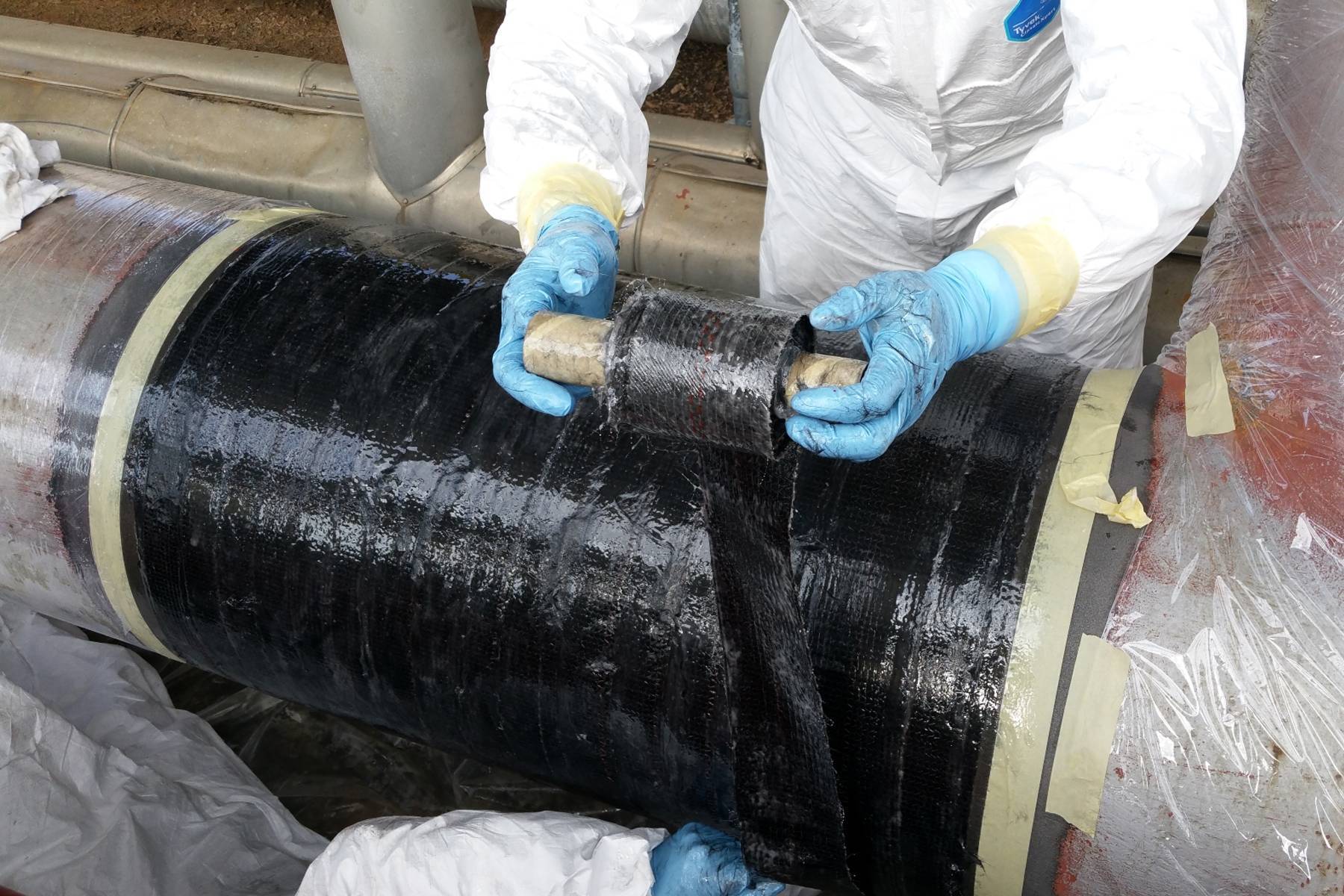
Primer goes onto the blasted surface and reaches its stated condition before wrapping begins. For hot-applied tape, the compound face is warmed with a torch to soften it without melting, and the tape then runs on in a spiral, wound under tension to achieve continuous contact with the pipe surface and minimise air entrapment, and each turn overlaps the one before it by the percentage your specification names. Overlap decides whether the finished wrap behaves as one continuous barrier or as a run of separate strips. Ends, tapers and the transition onto a fitting are wrapped by hand, because that is where a wrap most often lifts.
-
Inspection and Handover
Every wrapped length is checked before it leaves our control. We look at overlap consistency, wrap tension, total build and continuity, and anything found gets re-wrapped and re-checked on the spot. Coating reports and test certificates are issued against the job number and travel with the pipe. The detailed application and inspection sequence is controlled by the project coating specification and approved procedure.
Coal Tar Tape Thickness and Performance
Applied thickness, service temperature and barrier behaviour are the three performance questions a specification asks of a coal tar tape wrap, and your document answers the first of them.
Applied Thickness
Tape thickness and the number of layers come from your project specification, and we wrap to those figures. Tape thickness and roll dimensions depend on the specified product; the finished coating build is determined by tape thickness, layer count and overlap.
Operating Temperature Range
Service temperature follows the specified tape. IS 15337 covers coal tar tape for pipelines operating at up to 50 °C, and any higher limit must be confirmed. The applicable temperature range should be confirmed against the actual operating temperature and specified enamel grade.
Barrier Behaviour Under Soil and Water
Coal tar enamel takes up very little water, and that low uptake keeps a buried wrap working under permanently damp backfill. The tape also insulates the steel electrically, so stray current and the electrolytic corrosion it drives have a harder path to the metal. Cathodic protection still does its own job, and a sound coal tar-impregnated tape wrap lowers the current the system has to push.
Send Us Your Pipe Schedule for a Coating Quote
ISO 9001 certified coating operations, running from Mumbai since 2012 with pan-India execution. Factory photos, video of live application and a sample test certificate are available on request.
Coal Tar Tape Testing and Inspection
Tape wraps are inspected differently from sprayed or powder films. On the pipe, the key checks are overlap, tension, continuity and bond, while material quality is confirmed by the tape and primer tests in the governing standard. Four checks run on our coal tar tape work.
-
Overlap and tension across the wrap
We measure the overlap achieved against the percentage your specification states, and we look at how tightly each turn beds down. Insufficient tension or overlap can create discontinuities and localised coating defects that reduce protection in service.
-
Continuity and holiday detection
An electrical holiday test walks the wrapped surface and finds voids, pinholes and gaps at the spiral edge. Any location that registers is re-wrapped and re-tested before the length is signed off.
-
Total applied build
Thickness is confirmed against the layer count and tape gauge your document specifies to verify that the applied coating build meets the specified requirements.
-
Bond and lift resistance
We check that the tape has taken to the primer and that edges, tapers and fitting transitions show no lifting. Edge lifting identified during inspection requires correction because exposed edges can permit moisture ingress and progressive coating disbondment.
Primer is checked for dryness before wrapping, and adhesion testing on the applied tape follows the curing time the specification sets (a minimum of 72 hours under IS 15337). Third-party inspectors named in your contract witness the same checks alongside our own people.
Coal Tar Tape Coating Industrial Applications
Coal tar tape goes onto buried steel pipe carrying water and industrial fluids, onto above-ground steel pipework in some duties, and onto older lines being brought back into condition. Three application groups are described below.

Water Transmission and Raw Water Mains
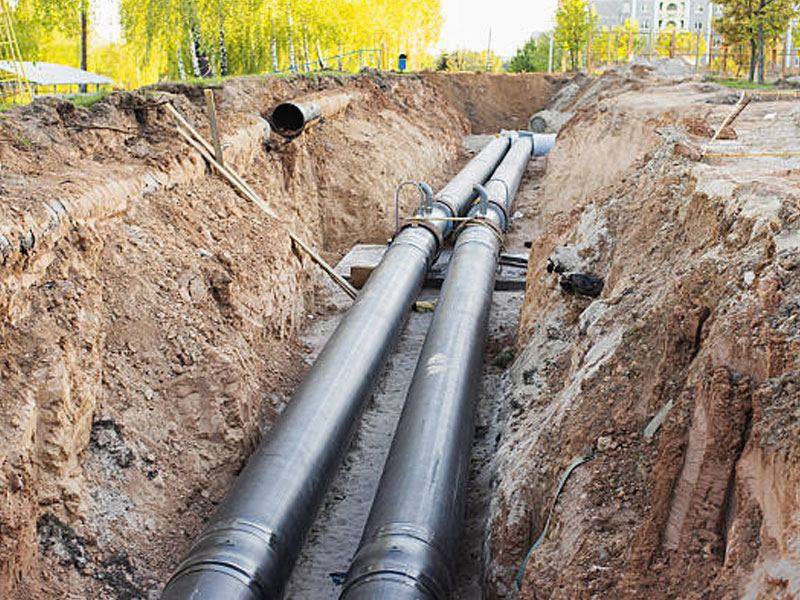
Underground water transmission is a key application for coal tar tape in India. Transmission mains cross soil that changes every few kilometres, get buried once, and then have to hold for the design life of the scheme. Raw water lines from a reservoir to a treatment works sit in the same category. Water supply authorities and EPC contractors buy this work, and coal tar tape carries the record their consultants already know.
Buried Plant and Utility Pipework
Inside plant boundaries, buried service lines, fire water mains and utility headers run through congested ground with denser fitting counts than a cross-country route carries. A tape system suits that geometry, since the same wrap goes round a bend, a reducer and a flange back without anybody changing the process. Re-excavation is expensive here, so these specifications get written conservatively.
Above Ground Steel Pipelines
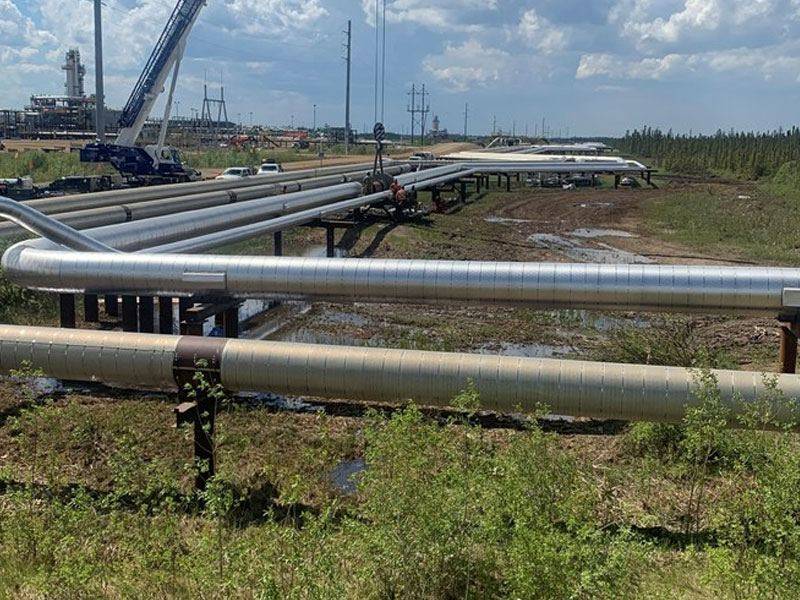
Some above-ground steel pipework is wrapped with coal tar tape where a specification calls for it, usually on runs that move between buried and exposed sections. Coal tar tape is designed for buried service, so exposed sections need protection from sunlight, such as whitewash or a covering, as the project specification requires.
Coal Tar Tape Coating Cost
We price wrapping per square metre, with 200 square metres as the order floor. A single published rate would not accurately represent the cost of different coating requirements. Three variables move a quotation for coal tar tape coating in India:
- Outside diameter and total wrapped length, which together set the coated area
- Tape thickness, layer count and overlap called for by your specification
- Component mix, as bends, fittings and flange backs need more hand work per square metre than straight barrel
Why Choose Radisson Impex for Coal Tar Tape Coating
Three things are worth weighing before coal tar tape wrapping is placed anywhere, and the same team runs our wider pipe coating services.
- Bends, fittings and flanges take the same wrap as the straight lengths beside them, since the method is indifferent to the shape underneath.
- Blasting is to Sa 2½, and tape thickness and overlap come out of your specification.
- Overlap, continuity, build and bond findings go out as certificates and a coating report, and witnessed inspection gets arranged whenever a contract calls for it.
Coal Tar Tape Coating: Frequently Asked Questions
What is Coal Tar Tape made from?
Coal tar tape is made of a coal tar pitch compound with mineral filler, coated on both sides of a glass fibre mat reinforced with continuous glass yarn. A thin film separator stops the roll layers from sticking and is peeled off before wrapping.
Which Indian standards cover Coal Tar Tape?
IS 15337:2003 sets the material and application requirements for coal tar based anticorrosion tape for underground mild steel pipelines. IS 10221:2008 is the code of practice for hot-applied coal tar enamel coating and wrapping of underground mild steel pipelines.
Is Coal Tar Tape the same thing as Coal Tar Epoxy?
No. Coal tar epoxy is a two-component liquid that is brushed or sprayed and cures by chemical reaction. Coal tar tape is a glass fibre mat coated on both sides with coal tar. It is warmed with a torch and wound spirally over a primed pipe.
How does Coal Tar Tape compare with Bitumen Tape?
Coal tar tape resists soil bacteria and dissolves very little in petrol (IS 15337 allows a maximum 5% weight loss after 24 hours). IS 15337 notes that bitumen-based tape can be attacked by soil bacteria and states that coal tar tape, not bitumen tape, should be used on underground pipelines. The final choice follows your approved tender specification.
What temperature can a Coal Tar Tape wrap withstand?
Standard Coal Tar Tape per IS 15337 is designed for pipelines operating at continuous temperatures up to 50°C, which covers typical buried municipal water, wastewater, and raw industrial cooling lines.
Which pipe sizes and materials can you wrap?
We wrap pipes from 1 inch to 200 inch outside diameter, in single lengths up to 18 metres. Substrates include mild steel, LTCS and alloy steel pipe. For carbon steel line pipe, we wrap API 5L Grade B through X120.
Contact Us About Coal Tar Tape Wrapping. Send us the pipe schedule with the governing coating specification, and scope, timing and price come back from us.