
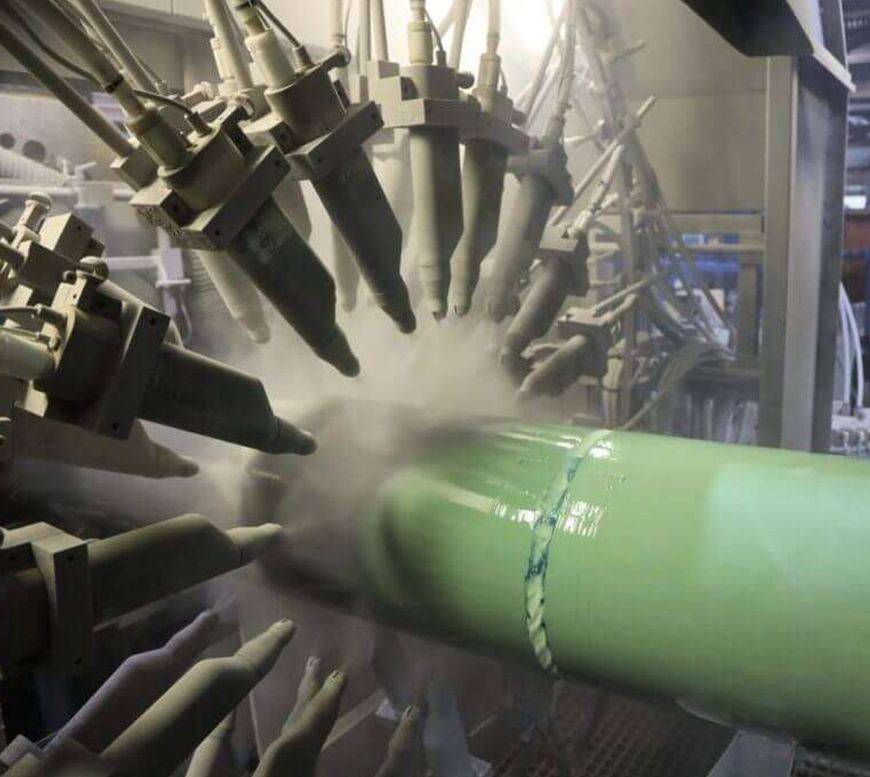
FBE coating, or fusion-bonded epoxy coating, is a thermosetting epoxy powder coating applied to prepared steel to provide a corrosion-resistant barrier. The steel is cleaned and heated before the epoxy powder is applied electrostatically. When the powder contacts the hot steel surface, it melts, flows into the prepared surface profile, and then cures into a hard, continuous film.
The curing process creates a chemically cross-linked coating that cannot be remelted like a thermoplastic coating. The cured FBE coating acts as a barrier between the steel and corrosive elements such as moisture, oxygen, and dissolved salts. FBE coating in Mumbai is used for steel pipes, valves, fittings, and other components where corrosion protection is required for the intended service conditions.
Radisson Impex, a Mumbai-based pipe coating contractor, provides FBE coating in India for projects requiring fusion-bonded epoxy. We hold ISO 9001 certification and were established in 2012. We apply single-layer FBE, dual-layer FBE, and an extra protection layer over the epoxy on seamless, ERW, LSAW, and spiral-welded mild steel, LTCS, and alloy steel pipe, with outside diameters ranging from 1 inch to 200 inches and lengths up to 18 metres, and for internal lining from 3 inch to 200 inches, with a maximum weight of 24 tonnes per pipe. Fittings, bends and flanges are coated to the same film specification as straight lengths. Surface preparation meets Sa 2½, the coating is applied to the film thickness in your specification, and every job ships with test certificates. EPC contractors and government tenders form our primary business.
FBE Coating Service Options
Applied at our Vasai factory or at your project site, pan India.
-
At our facility
Factory coating
- Vasai factory
- Pipe transport arranged
-
At your project site
Onsite coating
- Pan India
- Coated at your project site
-
For existing pipes
Re-coating
- Old, used or rusted pipe
- Stripped, blasted, recoated
The FBE Coating System Explained
The FBE coating system is a bonded epoxy film, and the choices inside it are the number of layers, whether a further protection layer goes over the top, and which surface receives it. Four sub-sections cover the chemistry, single versus dual layer, the overcoat, and the external and internal cases.
-
Fusion Bonded Epoxy as a Thermoset Powder
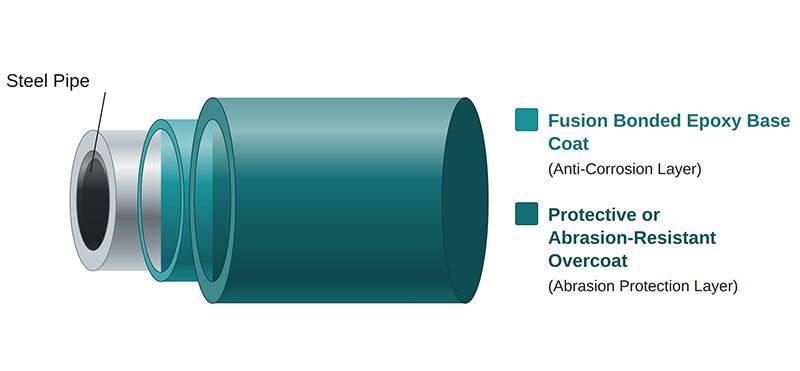
Fusion bonded epoxy coating consists of a thermoset polymer system in a dry powder, with resin, hardener, pigments and fillers already blended in the correct ratio. Liquid coatings usually form their film as a solvent carrier evaporates; powder contains no solvent. Steel heat causes the chains to cross-link, creating a molecular network instead of dry layers. That network won't re-melt, hence FBE coatings behave differently from thermoplastic jackets.
-
Single Layer and Dual Layer FBE
Single-layer FBE provides adhesion to the steel substrate, corrosion protection, and resistance to cathodic disbondment within one epoxy film. Dual-layer FBE puts a second bonded epoxy layer over the base coat while the base is still hot enough to fuse with it. The base layer does the corrosion work; the second layer takes the mechanical duty: impact and gouging during loading, stringing and backfill. CSA Z245.20 names the variants: System 2A with a protective overcoat, System 2B with an abrasion-resistant overcoat (the ARO build), and System 2C with an anti-slip overcoat. System 3 is a three-layer build: an anti-slip overcoat applied over the anti-corrosion coat and a protective overcoat. This is different from 3LPE coating, where FBE is only the primer under an adhesive and an extruded polyolefin jacket.
-
The Additional Protection Layer
An abrasion-resistant overcoat, commonly specified as an ARO layer, is applied where the pipe faces higher abrasion during installation or service. Horizontal directional drilling, thrust boring, and rocky backfill require an additional protection layer. The epoxy underneath still does the corrosion work; the overcoat gets the film into the trench intact. The additional protection layer is applied as part of the FBE scope rather than as a separate coating system.
-
External and Internal Application
External FBE pipe coating protects the outside wall of buried and submerged line pipe against soil, groundwater and chemical attack. Diameter, blast grade and film thickness on that scope are part of the external FBE coating. Internal FBE works the other way round. It lines the bore where the conveyed fluid is the corrosive medium, and because the cured surface is smooth, it also cuts friction and turbulence in the flow, which is why drinking water mains, sewage rising mains and process lines are the usual candidates for an epoxy lining.
FBE Coating Specifications
The fusion bonded epoxy coating specifications below set the scope boundaries of what we coat and supply, covering the coating systems, pipe and substrate types we accept, and size and weight limits.
| Parameter | Scope |
|---|---|
| Coating system | Single layer FBE; dual layer FBE with a protective, abrasion-resistant (ARO) or anti-slip overcoat (CSA System 2A / 2B / 2C) |
| Surface coated | External wall, internal bore, or both |
| Pipe types accepted | Seamless, ERW, LSAW, spiral welded (HSAW) |
| Substrates accepted | Mild steel (MS black), LTCS, alloy steel |
| Line pipe | API 5L line pipe, Grade B through X120 |
| Components coated | Straight pipe, fittings, bends, flanges |
| Inside diameter range | 3 inch to 200 inches |
| Outside diameter range | 1 inch to 200 inches |
| Maximum pipe length | 18 metres |
| Maximum weight per pipe | 24 tonnes |
| Surface preparation | Abrasive blast cleaning to Sa 2½ with the anchor profile stated in your specification |
| Coating thickness | Applied to the thickness stated in the customer specification |
FBE Coating Standards
The FBE coating standard named in your tender governs qualification, film thickness, the test regime and the acceptance criteria, and we execute according to that document. ISO 21809-2 is the international reference for single-layer FBE on line pipe, and AWWA C213 is what water utilities work on.
Country / Region / Designation / Standard title
- International (ISO)
- ISO 21809-2:2026Oil and gas industries, including lower-carbon energy. External coatings for buried or submerged pipelines used in pipeline transportation systems. Part 2: Single-layer fusion-bonded epoxy coatings. Third edition, replacing ISO 21809-2:2014
- Europe (CEN)
- EN ISO 21809-2:2026Adoption of ISO 21809-2:2026 without modification, approved by CEN in February 2026
- United States (AWWA)
- AWWA C213-22Fusion-Bonded Epoxy Coatings and Linings for Steel Water Pipe and Fittings. Covers interior and exterior surfaces; revision of ANSI/AWWA C213-15
- United States (NACE)
- NACE SP0394-2023Application, Performance, and Quality Control of Plant-Applied Single-Layer Fusion-Bonded Epoxy External Pipe Coating
- Canada (CSA)
- CSA Z245.20, ninth edition, in CSA Z245.20 Series:22Plant-applied external fusion bond epoxy coating for steel pipe
- China (SY/T)
- SY/T 0315-2013Technical specification of external fusion bonded epoxy coating for steel pipeline
Reviewing the scope limitations is crucial before citing a designation. ISO 21809-2 and NACE SP0394 both govern single-layer FBE applied externally to bare steel pipe, meaning a dual-layer build must be specified by exception. For steel water pipe, AWWA C213 governs FBE on the internal surface, the external surface, or both.
Features and Benefits of FBE Coating
Six properties explain why fusion-bonded epoxy remains the reference anti-corrosion film for steel pipe, and each one lands on the project as either cost or risk.
-
A thin film that still holds the corrosion line
FBE protects at a fraction of the build of a jacketed system, so the coated outside diameter barely changes. Trench width, sleeve clearances and pull-through loads stay where the design put them.
-
Adhesion to the prepared steel surface
The molten coating wets and conforms to the blast profile before curing, creating a bonded interface with the prepared steel surface. Resistance to cathodic disbondment helps maintain coating adhesion when the pipeline operates with cathodic protection.
-
Both surfaces are from one process
FBE can be specified for both external protection and internal lining, with the material, application, and inspection requirements established for each service.
-
Damage tolerance can be specified upward
Where handling is rough, a dual-layer FBE or an abrasion-resistant overcoat goes onto the same base coat rather than moving the scope elsewhere.
-
Established standards for qualification and inspection
ISO 21809-2, AWWA C213, NACE SP0394 and CSA Z245.20 describe the same coating family, so inspection criteria are already written.
-
Repairable before release
Holiday detection locates discontinuities in the film, and those spots are repaired and re-tested within the repair limits of your standard.
FBE Coating Process
Our fusion bonded epoxy coating process covers blasting, pre-heating, electrostatic spraying, curing, cooling and holiday testing, with the same film build achieved on straight lengths and on complex components.
-
Surface Preparation
Abrasive blast cleaning takes the steel to Sa 2½ (ISO 8501-1), the very thorough blast-cleaning grade that FBE powder systems need. Mill scale, rust, grease and any previous coating come off, and the profile left behind gives the melted powder something to key into. Profile is one of the controls that decide adhesion, alongside cleanliness, dust and salt levels, and the time between blasting and coating, so we inspect the blasted surface before the powder is released.
-
Powder Application and Cure
The blasted pipe is pre-heated, then electrostatically charged epoxy powder is sprayed onto the hot steel. Melting, flow-out and gelling happen within seconds. Cure follows from the heat stored in the pipe wall, so the schedule depends on wall thickness, line speed and powder grade. We take the pre-heat band and cure window from the FBE coating data sheet for the material specified in your specification.
-
Cooling and Handover
After the specified cure cycle, the pipe is cooled, including controlled water quenching where applicable, before inspection. Dry film thickness, holiday detection, adhesion and cure results are recorded against the job number, and any holiday found is repaired and re-tested. Inspection records and coating documentation are issued with the completed pipe.
FBE Coating Thickness and Performance
FBE coating thickness is set by your project specification rather than by a company standard, and we apply and verify the figure your document states. The three sub-sections below cover thickness, the temperature question, and resistance behaviour.
Coating Thickness to Your Specification
Your specification sets the fusion bonded epoxy coating thickness, drawing on the standard the project works to. A dual-layer build carries a total figure and a base coat figure, both read off the same document.
Application and Service Temperature
Application temperature and service temperature are separate parameters and should not be treated as interchangeable. Application temperature is the pre-heat the steel reaches before the powder is sprayed, and it comes from the powder grade. The in-service ceiling is a property of the cured resin, and FBE coating temperature limits differ sharply between a standard grade and a high-temperature grade. We won't publish one figure against either, because the answer sits on the material data sheet.
Corrosion, Abrasion and Chemical Resistance
The cured epoxy resists the soil chemistries, groundwater and chloride exposure that buried and coastal lines run through, and it holds up against solvents and process fluids inside a plant boundary. Abrasion varies most with the build. A single-layer film is thin and hard but has limited reserve against gouging, which is why dual-layer FBE and abrasion-resistant overcoats exist.
Send Us Your FBE Coating Schedule for a Coating Quote
ISO 9001 certified coating operations, running from Mumbai since 2012 with pan-India execution. Factory photos, video of live application and a sample test certificate are available on request.
FBE Coating Testing and Inspection
Coating quality is confirmed by measurement and documented records. Inspection and testing are performed in accordance with the project specification and applicable coating standard, including the following checks where specified:
-
Dry film thickness (DFT)
Readings are taken across the coated surface and compared against the thickness your specification states, on the base coat as well as the total build where a dual layer system applies.
-
Holiday or spark testing
An electrical test locates pinholes and discontinuities in the film. Anything the detector finds is repaired and re-tested before release.
-
Adhesion testing
We check bond strength to the steel with the adhesion test your standard names, such as the knife adhesion test, since that property decides how the coating behaves in the trench and under cathodic protection.
-
Curing testing
We verify the cure state, so the epoxy has developed its designed cross-link density before the pipe moves.
Third-party inspection agencies are accommodated where your contract calls for witnessed testing. Test certificates and coating reports go out with the job, and procurement awards a coating package on that documentation.
FBE Coating Industrial Applications
Fusion bond epoxy coated pipe goes into buried and submerged steel pipelines carrying crude oil, natural gas, drinking water and industrial fluids and into the bends and fittings installed with them. Four groups use most of the epoxy-coated pipes we handle.

Oil and Gas Pipelines
Cross-country crude and natural gas transmission lines are the original and still the largest application for pipe FBE coating. Design life runs to decades and access is close to nil once the line is buried, so the film has to survive construction and then work untouched. City gas networks use the same system at smaller diameters.

Water and Sewage Pipelines
Water utilities specify FBE on both surfaces of large diameter steel mains, which is the case AWWA C213 was written around. The external film handles the soil; the internal lining is selected for the conveyed fluid and its associated chemical and immersion conditions. Irrigation schemes run the same build.
Chemical and Petrochemical Plant Piping
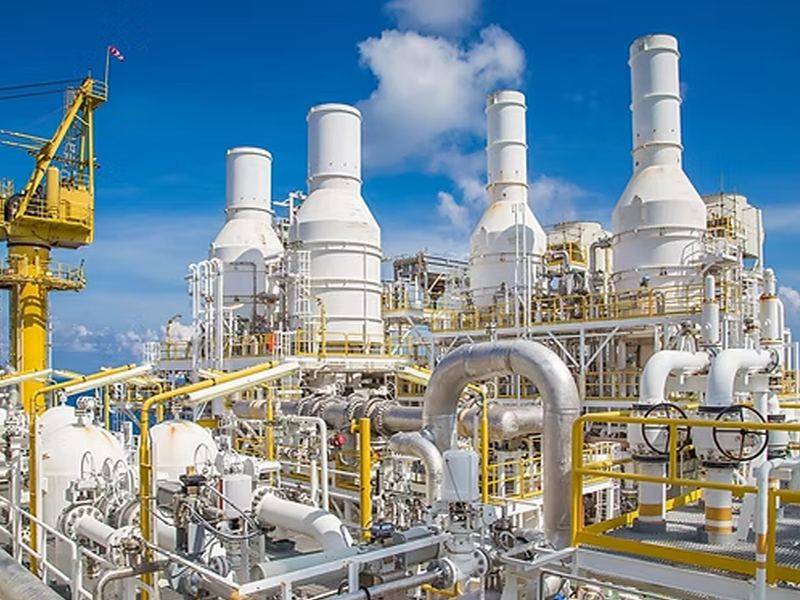
Plant piping meets a different kind of exposure. Buried process lines, fire-fighting mains and interconnecting pipework face solvents, spillage and congested routing with more fittings per metre than a cross-country run. Coated bends and flanges matter more here than straight pipe.
Buried and Coastal Pipelines
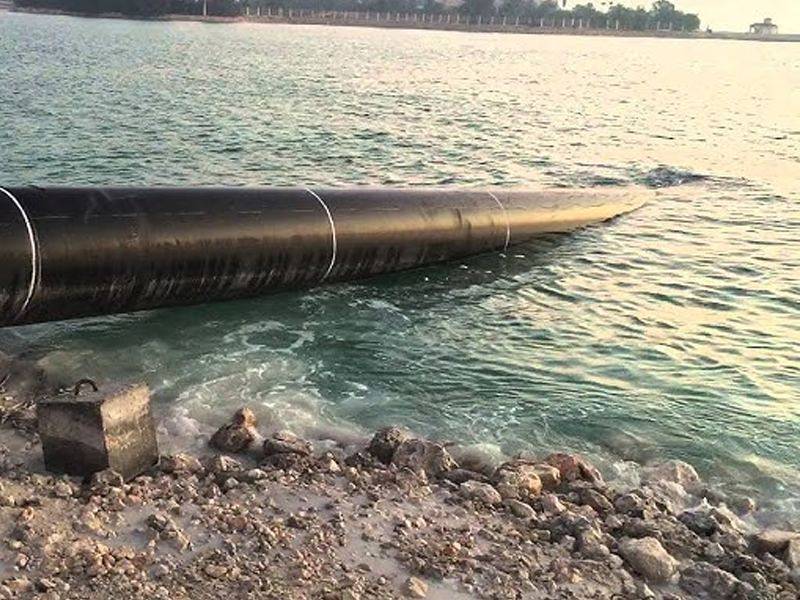
River crossings, coastal approaches and any section below the water table put the coating in permanent contact with moisture and dissolved chlorides. Saline groundwater is the harshest routine duty an anti-corrosion film sees onshore, and continuous water contact is where a poorly prepared substrate shows up first.
FBE vs 3LPE vs Liquid Epoxy: Choosing the Right System
Choose single layer FBE where a thin, fully bonded epoxy film is specified and handling is controlled. Choose dual layer where the pipe faces impact or abrasive backfill. Choose a polyolefin system where a thick mechanical jacket is called for, and a liquid epoxy where a wet film suits the item better than powder.
Liquid epoxy and fusion bonded epoxy differ in how the film is formed rather than in the resin family. Where a high build polyolefin is specified instead, the operating temperature of the line decides between 3LPE and 3LPP coating.
| Factor | Single layer FBE | Dual layer FBE | 3LPE and 3LPP | Liquid epoxy |
|---|---|---|---|---|
| Build | One thermoset epoxy film | Epoxy base coat plus a bonded second layer | 3LPE: FBE primer, copolymer adhesive, polyethylene jacket 3LPP: FBE primer, copolymer adhesive, polypropylene jacket | Liquid resin applied wet and cured |
| Mechanical protection | Limited | Higher | Highest | Limited |
| Application method | Powder onto pre-heated steel | Powder in two passes onto pre-heated steel | Powder plus extruded jacket | Spray, brush or roller |
| Relative cost | Lowest | Moderate | Higher | Varies by product |
| Common use | Buried line pipe, water mains, internal lining | Drilled crossings, rocky backfill, heavy handling | Buried and submerged lines needing a jacket | Duties where a wet film is specified |
FBE Coating Cost
Coating work is charged per square metre, against a minimum order of 200 square metres, and a normal job runs to about 7 days. There is no single fusion-bonded epoxy coating price, because the same square metre of pipe prices differently depending on what it is and how it is specified. These are the factors that affect the quotation number:
- Pipe outside diameter and the total coated area in the schedule
- Which system is called for: single layer, dual layer, or FBE with an additional protection layer
- Whether the external wall, the internal bore, or both surfaces are in scope
- Specified film thickness and the standard and test regime behind it
- Component mix, as bends, fittings and flanges take more handling per square metre than straight lengths
Contact us for optimal project rates. Scale improves square-metre pricing; please share your full schedule.

Why Choose Radisson Impex for FBE Coating
Our FBE coating scope covers coating application, complex components, and documented inspection.
- Single-layer, dual-layer, and overcoated builds are quoted from one schedule, so the layer decision stays open until the installation method is settled and the ground conditions are known.
- Complex geometry is not a problem. Fittings, bends and FBE coated flanges take the same film as straight pipe.
- DFT, holiday, adhesion and curing results are issued as certificates and coating reports, with third-party inspection accommodated on request.
FBE Coating: Frequently Asked Questions
What is FBE Coating and what does FBE stand for?
FBE stands for fusion-bonded epoxy. FBE coating is a thermoset epoxy powder sprayed electrostatically onto pre-heated steel, where it melts, flows into the blast profile and cross-links into a hard, continuous film. The cured film bonds firmly to the steel and protects buried and submerged pipelines against corrosion.
How is FBE Coating applied to Pipe?
Blast to Sa 2½, pre-heat the steel, spray charged epoxy powder onto the hot surface, let it melt and cure, then cool and inspect. Straight lengths and complex components are both handled to the same film specification.
How is FBE Coating removed from Pipe?
Cured FBE Coating cannot be melted off because the cross-linking chemical reaction is irreversible. It is removed mechanically by abrasive blasting back to bare steel.
Can you apply FBE Coating inside the Pipe as well as outside?
Yes. Internal FBE Coating is applied to prevent internal line corrosion and create an ultra-smooth bore that significantly reduces fluid flow friction. Provide the nominal bore and pipe cut lengths with your inquiry to confirm application tooling.
What is the difference between Single Layer and Dual Layer FBE Coating?
Single layer FBE is one bonded epoxy film doing the corrosion work. Dual-layer FBE adds a second bonded epoxy layer on top of it, and that second layer takes the mechanical punishment from directional drilling, rocky backfill and rough handling. When the overcoat is the abrasion-resistant grade, tenders call it ARO. CSA Z245.20 lists the variants as System 2A, 2B and 2C.
What FBE Coating thickness do you apply?
Thickness is tailored directly to your project specification and design code requirements rather than a generic standard. We review your coating schedule, provide verified dry film thickness (DFT) ranges during quotation, and inspect every joint with calibrated magnetic gauges.
Is FBE Coating the same as Powder Coating or paint?
Not the same as decorative powder coating or paint. FBE is a type of powder coating, but it is a functional epoxy powder fused onto pre-heated steel and qualified against pipeline standards for adhesion, cathodic disbondment and holiday-free continuity. Decorative powder coatings are made for appearance and are not qualified for buried or submerged pipelines. Liquid paints form their film wet, by solvent release and cure, not by fusing a powder.
Contact Us for Coating Availability. Send your pipe schedule and coating specification, and we'll confirm scope and price against your document.