
Pipe coating applies a protective layer to a pipe's exterior or interior surface to prevent corrosion, abrasion, and chemical damage. Uncoated steel pipe corrodes when exposed to soil moisture, seawater, or industrial chemicals, shortening service life and raising maintenance costs.
A coating system creates a vital barrier between the pipe and its environment. Depending on the application, engineers utilise options like fusion-bonded epoxy, multi-layer polyethene, or cement mortar lining, choosing each system based on the pipe's specific operating environment and expected service life.
Established in 2012, we at Radisson Impex are a Mumbai-based, ISO 9001-certified contractor providing pipeline coating services across India. We coat your pipes and supply coated steel pipe, handling 1–200” OD and 3–200” ID plain barrels, bends, fittings, and flanges. Our capabilities cover seamless, ERW, LSAW, and spiral-welded products in MS black, LTCS, alloy steel, and API 5L Grade B to X120. We re-coat in-service pipe by recovering it to bare metal, processing lengths up to 18m and weights to 24 tonnes, shot-blasting to Sa 2½ (or custom grades), and applying your client-specified thicknesses. Serving EPC contractors and government schemes, factory- or site-wide, our pricing is per square metre with a 200 m² minimum.
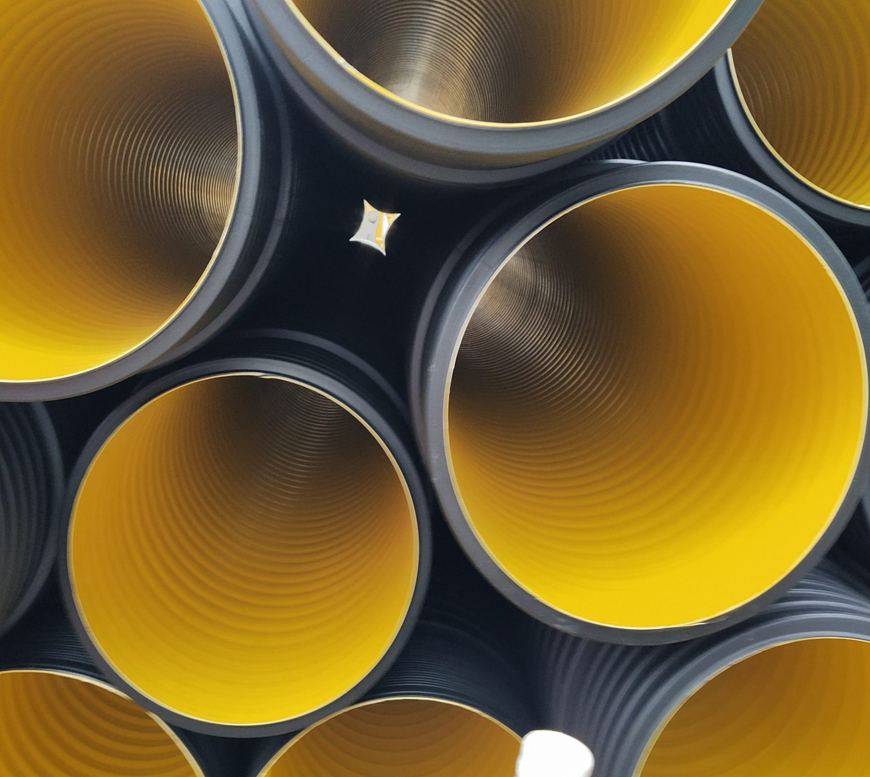
Pipe Coating Service Options
Applied at our Vasai factory or at your project site, pan-India.
-
At our facility
Factory coating
- Vasai factory
- Pipe transport arranged
-
At your project site
Onsite coating
- Pan India
- Coated at your project site
-
For existing pipes
Re-coating
- Old, used or rusted pipe
- Stripped, blasted, recoated
How Pipe Coating Interrupts Corrosion
Corrosion on a steel pipeline is an electrochemical reaction, and coating slows it by keeping the electrolyte away from the steel surface. Anodic and cathodic sites form on the same length of metal wherever an electrolyte bridges them. Soil moisture provides that bridge on a buried line, while produced or raw water inside a bore does so too. Metal dissolves at anodic sites, reducing wall thickness locally; depending on the environment, corrosion may develop as general attack or localised pitting.
Cathodic protection current concentrates at exposed steel and coating defects, so coating quality drives current demand across the pipeline's service life. Low water uptake and resistance to cathodic disbondment matter as much as the barrier property itself.
Mechanical damage is the other half of the problem. Loading, stringing and backfill account for most coating damage before a line ever enters service. Steel pipe coating gets specified around barrier performance and impact resistance together, not one or the other.
Pipe Coating Specifications
The figures below define the overall range our pipe coating services accept; each coating system has its own size window within it, which we confirm at enquiry.
| Parameter | Scope |
|---|---|
| Service | External and internal coating applied to the customer's pipe, at our factory or at your project site |
| External diameter range | 1 inch to 200 inches |
| Internal diameter range | 3 inches to 200 inches |
| Pipe types accepted | Seamless, ERW, LSAW, spiral welded (HSAW) |
| Substrates accepted | Mild steel (MS black), LTCS, alloy steel |
| Line pipe | API 5L line pipe, Grade B through X120 |
| Components coated | Straight pipe, fittings, bends, flanges |
| Substrate condition | New pipe, plus cleaning and re-coating of old, used or rusted pipe |
| Maximum pipe length | 18 metres |
| Maximum weight per pipe | 24 tonnes |
| Surface preparation | Abrasive shot blasting, normally to Sa 2½, or to the grade your specification sets |
| Coating thickness | Applied to the thickness stated in the customer specification |
Pipe Coating Standards
Each pipeline coating type carries its own standards, and we execute against whichever document your tender cites. The table groups the principal standards by coating system; the project specification should govern where editions or equivalent standards differ.
| Coating system | International (ISO) | India (IS) | Other designations |
|---|---|---|---|
| 013LPE and 3LPP, plant applied | ISO 21809-1:2018 |
|
|
| 02Fusion bonded epoxy, single layer | ISO 21809-2:2026 |
|
|
| 03Liquid epoxy | Not covered by a dedicated ISO 21809 part |
|
|
| 04Coal tar systems | Not covered by a dedicated ISO 21809 part |
|
|
| 05Cold applied polyolefin tape | Not covered by a dedicated ISO 21809 part |
|
|
| 06Heat shrink sleeves and field coating materials | ISO 21809-3:2016with Amd 1:2020 |
|
|
| 07External concrete | ISO 21809-5:2017 |
|
|
| 08Cement mortar lining | Not covered by ISO 21809 |
|
|
| 09In-field application and rehabilitation | ISO 21809-11:2019 |
|
|
Types of Pipe Coating
Steel Pipe Coatings can be applied externally, internally or on both surfaces depending on the intended service.
External Pipe Coating
External pipe coating protects the outside of the pipe from soil, moisture, corrosive ground conditions and mechanical damage. 3LPE, 3LPP and external FBE cover most external corrosion protection specifications.
All external systems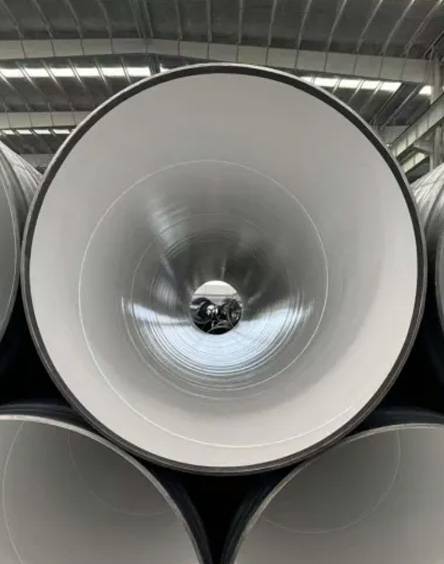
Three Layer Polyethylene (3LPE)
3LPE stacks a polyethene jacket over a copolymer adhesive over a fusion-bonded epoxy primer, fused together as one system. Buried onshore transmission pipe specifies it widely, with service temperature limits set by the coating specification and the qualified system. The epoxy layer carries the corrosion protection; the PE jacket absorbs whatever a construction crew does to the pipe on site.
Read more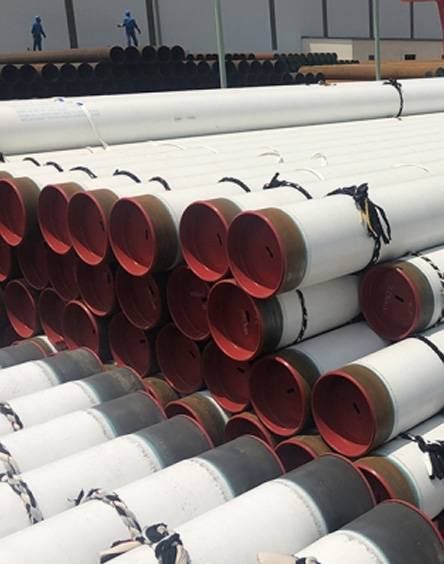
Three Layer Polypropylene (3LPP)
Polypropylene replaces the polyethene jacket where service temperature exceeds what PE holds continuous duty runs to around 110°C. PP also resists abrasion better, which is why it goes on lines pulled through rock. Higher service temperature is the usual reason to specify 3LPP, subject to the limits of the qualified system.
Read more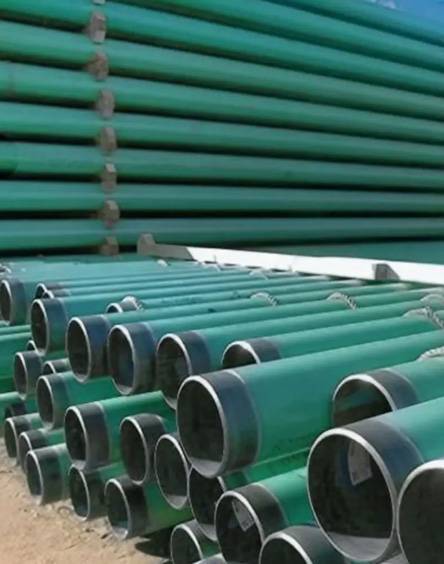
External Fusion Bonded Epoxy
Single-layer FBE is a thermoset epoxy film sprayed as a powder onto preheated steel with nothing applied over it. It bonds tightly, stays thin, and repairs easily, which suits scopes where mechanical exposure stays moderate. Double-layer FBE (DLFBE) and an abrasion-resistant overlay (ARO) extend the same epoxy pipe coating materials to rock trenches and directional drilling.
Read more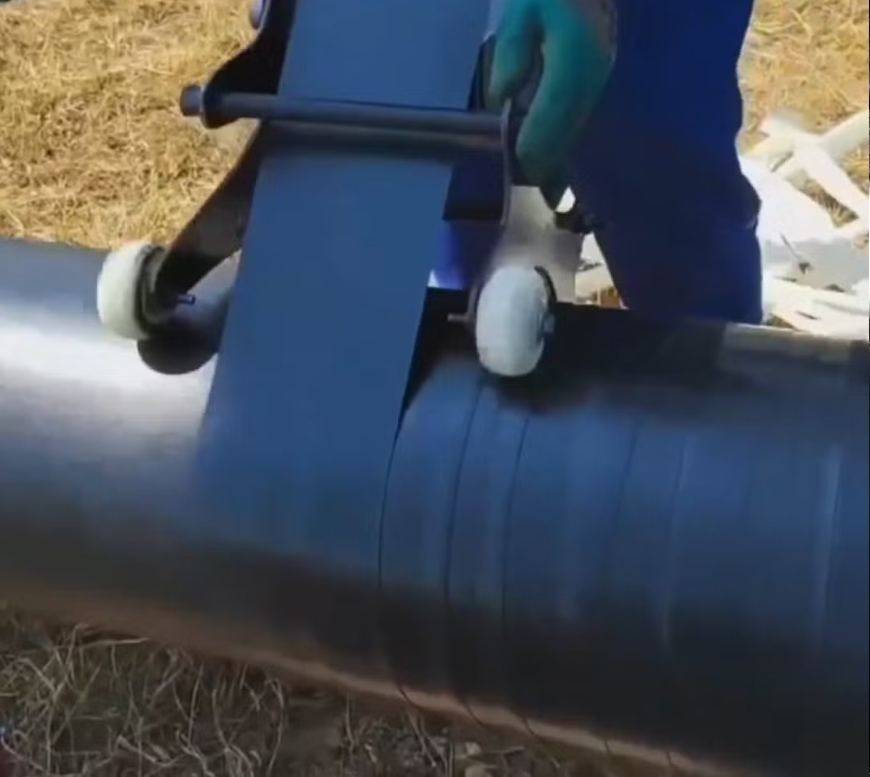
Tape Wrapping Systems
Tape wraps, also called tape coating, give on-site physical protection for irregular geometries, existing buried pipelines and short runs where plant processing makes no sense.
Read more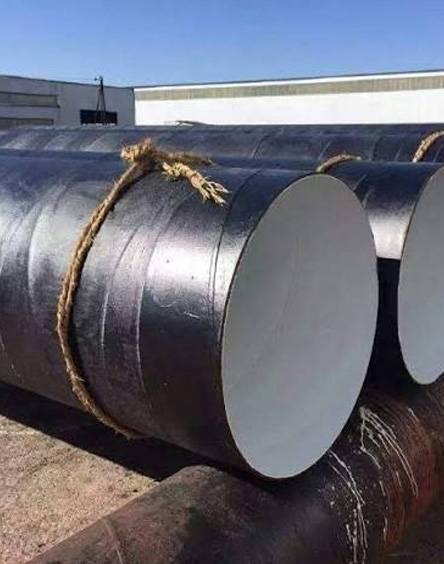
Coal Tar Tape Systems
Water and effluent infrastructure specifies these heavily reinforced coal-tar-based tapes extensively. They have thick, proven corrosion resistance for long-term underground burial.
Read more
Cold-Applied Polyolefin Systems
These polyolefin tape systems are applied in the field without open flames. They give a strong moisture barrier and conform well over field joints and straight pipe sections.
Read more
Heat Shrink Sleeves
A heat shrink sleeve is a cross-linked polyolefin wrap that recovers onto steel under heat, closing the cutback band every coated length carries at its ends. Sleeves belong at girth welds, tie-ins and fitting shoulders. Compatibility with the mainline system decides which sleeve suits a line an adhesive that keys well to polyethene behaves differently against bare epoxy.
Read more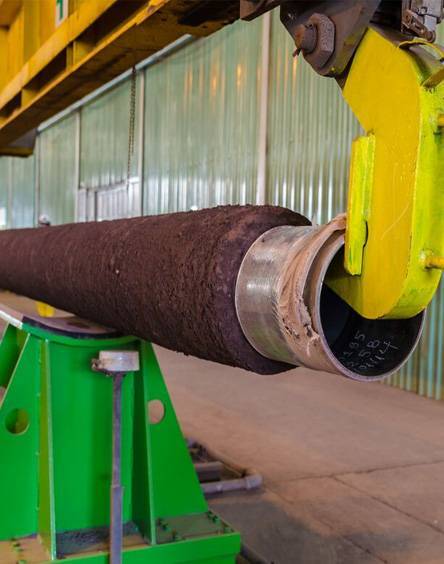
Concrete Weight Coating
Concrete weight coating, shortened to CWC in most tenders, is ballast laid over a finished anti-corrosion coat. It adds submerged weight, giving the coated pipe the negative buoyancy required in river crossings, flooded trenches and marine installations.
Read more
Internal Pipe Coating and Linings
Internal pipe lining protects the bore against the fluid a line carries and, on water mains, against the flow losses that tuberculation builds up over decades. Cathodic protection is applied to the external steel, so the internal lining must provide the specified protection against the conveyed fluid. The principal steel pipe coating types in our stated scope include external FBE, internal FBE, potable-water epoxy and cement mortar lining.
All internal linings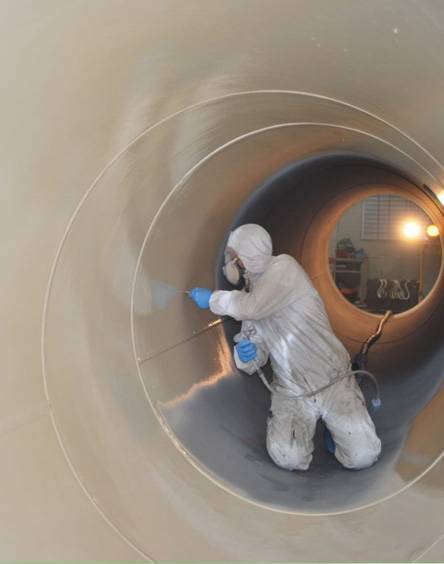
Internal Fusion Bonded Epoxy
Internal FBE lines the bore with the same thermoset powder used on the outside, melted and cured onto preheated steel. The film holds the transported fluid off the wall and leaves a smoother bore than blast-cleaned steel.
Read more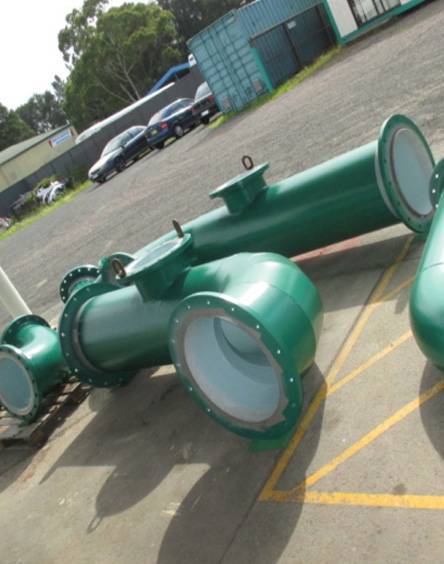
Glass Flake Reinforced Systems
Formulated with lamellar glass platelets, these heavy-duty coatings create a dense physical barrier against permeability, making them ideal for continuous severe immersion service. Along with being largely specified as an internal lining, glass flake coating can also be applied externally.
Read more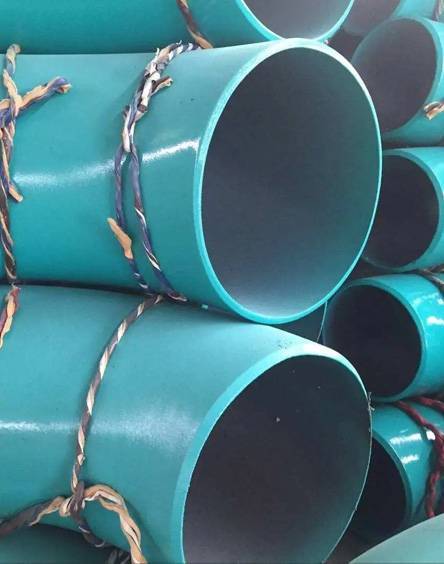
Potable Water Epoxy Lining
Potable duty puts a second test on a lining, because the material has to be safe in contact with drinking water as well as durable against it. We apply epoxies certified to NSF/ANSI/CAN 61, evaluated against the NSF/ANSI/CAN 600 health criteria, and, where a UK public water supply project requires it, products approved by the DWI under Regulation 31. Municipal mains and pumping station pipework are where the requirement appears.
Read more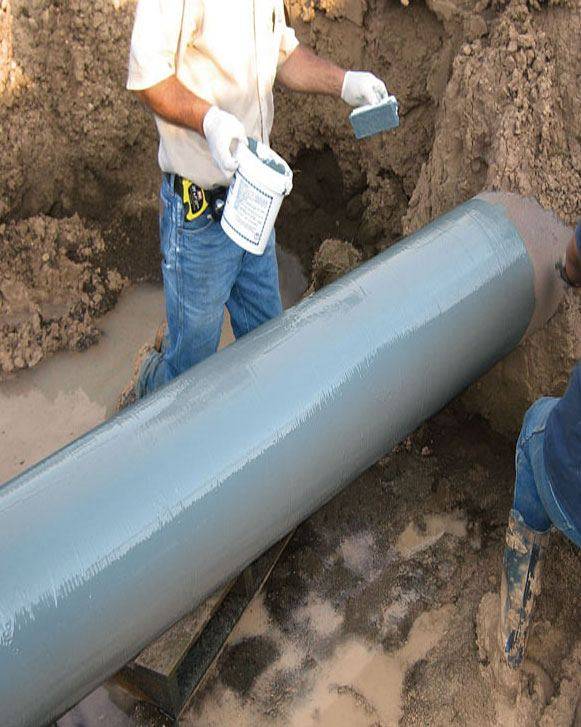
Phenolic Epoxy Systems
Engineered for highly aggressive chemical environments, phenolic epoxies provide advanced resistance to solvents, acids, and elevated operating temperatures inside processing pipelines. Although generally chosen as an internal coating, it can be applied as an external coating too.
Read more
Cement Mortar Lining
Cement mortar lining works chemically rather than as a barrier film. Hydrating cement holds the steel face at high alkalinity, and steel passivates in that condition instead of corroding, while the mortar body occupies the space tuberculation would otherwise fill. Large-diameter water mains are the standard application for cement mortar lining.
Read more
Coating on Fittings and Flanges
We at Radisson Impex also coat bends, elbows, tees, forged fittings and flanges alongside straight barrels, on one site, to your project specification. An extrusion line takes plain pipe only, so fittings run on sintered or flame-sprayed polyolefin and liquid epoxy, in a system compatible with the mainline coating. Sizes follow the main schedule, from 1 inch to 200 inches in outside diameter. Flange gasket faces are masked and left bare unless your specification says otherwise.
Features and Benefits of Pipe Coating
Six things a coated pipeline gives a project that a bare one cannot, and every one of them shows up somewhere in the budget.
-
A service life measured in decades
Steel in contact with soil and groundwater corrodes on a timescale that no pipeline programme can absorb. A sound barrier pushes that timescale out far enough that the coating, not the steel, becomes the thing being managed.
-
One decision covering several exposures at once
A buried line meets soil chemistry, moisture, mechanical loading and sometimes an aggressive product on the inside. Choosing the coating system settles most of those questions together rather than one at a time.
-
Cathodic protection stays within budget
A well bonded coating leaves only its defects for the CP system to look after, so current demand and anode replacement stay predictable across the life of the line.
-
The coating must withstand handling and installation damage before the pipeline enters service
More damage happens during loading, stringing and backfill than in service. Systems built with a mechanical outer layer arrive at the trench with fewer defects to repair.
-
Flow performance on the bore side
A smooth internal lining reduces friction loss and keeps the conveyed product away from the steel, which matters as much to pumping cost as to corrosion.
-
Acceptance rests on records rather than assurances
Thickness, holiday, adhesion and cure results are measured and issued as documents, so a coating package can be signed off on evidence.
Pipe Coating Process
The pipe coating process runs three stages, whatever system a job carries: surface preparation, application of the specified build, then inspection and release. Straight lengths in 3LPE and 3LPP are coated in the layer sequence the system requires. Flanges, bends and fittings are coated to the project specification, using a system and method compatible with the straight-pipe coating.
-
Surface Preparation
Blast cleaning runs a steel shot and grit work mix, normally bringing the steel to ISO 8501-1 grade Sa 2½, a near-white finish, or to the grade your specification sets. It lifts off mill scale, rust and any old coating, and leaves the 50 to 100 micron anchor profile that ISO 21809-1 calls for, which gives the primer a mechanical key.
-
Coating Application
Application method changes with the system, and so do the pipe coating materials that go behind each build. Powder is sprayed electrostatically onto hot steel and cures into a thermoset film. Adhesive and polyolefin follow over an FBE primer while the pipe still holds heat, and getting that sequence right is what fuses the layers into a single coating. Liquid epoxies are sprayed or applied by hand to the wet film thickness specified, tapes wrap over a primed surface at a set overlap, and concrete goes on over a finished anti-corrosion coat.
-
Inspection and Release
Every coated length gets checked before it leaves our control. Results are recorded against the job number, any defect found is repaired and re-tested, and the documentation travels with the pipe.
Send Us Your Pipe Schedule for a Coating Quote
ISO 9001 certified coating operations, running from Mumbai since 2012 with pan-India execution. Factory photos, video of live application and a sample test certificate are available on request.
Pipe Coating Testing and Inspection
Common inspection activities include dry-film thickness, holiday detection, adhesion and cure verification, as required by the coating specification.
-
Dry film thickness
Readings taken across the coated surface are compared with the figure your specification carries, since thickness governs barrier performance and acceptance alike.
-
Holiday detection
Holiday detection identifies pinholes and other electrically detectable discontinuities that may not be visible during visual inspection. Anything the detector picks up is repaired, then swept again.
-
Adhesion measurement
Bond strength between coating and steel, and between layers in a multi-layer build, decides whether a system stays put under soil stress and thermal cycling.
-
Cure verification
Thermoset systems reach their designed properties only when the cure is complete, so the cure state is confirmed before a length moves.
Witnessed testing is arranged where a contract appoints an inspection agency, and coating reports leave with the pipe. Procurement teams weigh that documentation as heavily as the coating itself.
Pipe Coating Industrial Applications
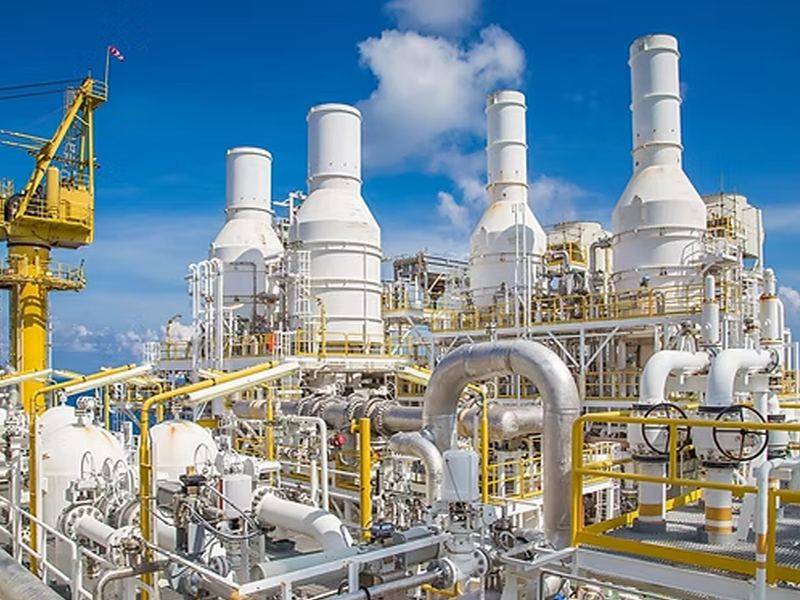
Pipeline coating protects critical steel pipe infrastructure across six major sectors, addressing unique environmental exposure and operating conditions for each industry.

Oil and Gas
Plant-applied external coatings shield cross-country crude, refined product, and natural gas transmission lines. These robust systems protect long-distance buried lines against aggressive soil chemistry and mechanical wear.

Water Supply and Sewage
Large-diameter municipal mains and irrigation pipelines utilise internal linings for potable water alongside heavy-duty external coatings to withstand constantly shifting, corrosive soil environments.
City Gas Distribution
Steel sections of urban CGD networks are commonly specified with three-layer PE coating on straight pipe, with bends and fittings coated in a compatible system, to protect buried steel against corrosion.
Chemical and Process Plants
Buried industrial process pipelines, effluent transport systems, and plant fire-fighting mains rely on targeted coatings to resist congested underground routing and exposure to aggressive fluids.
Power and HVAC
Cooling water circuits, condenser lines, and chilled water piping receive protective coatings designed to prevent corrosion from raw water, continuous condensation, and cooling tower chemical treatments.
Marine, Ports, and Construction
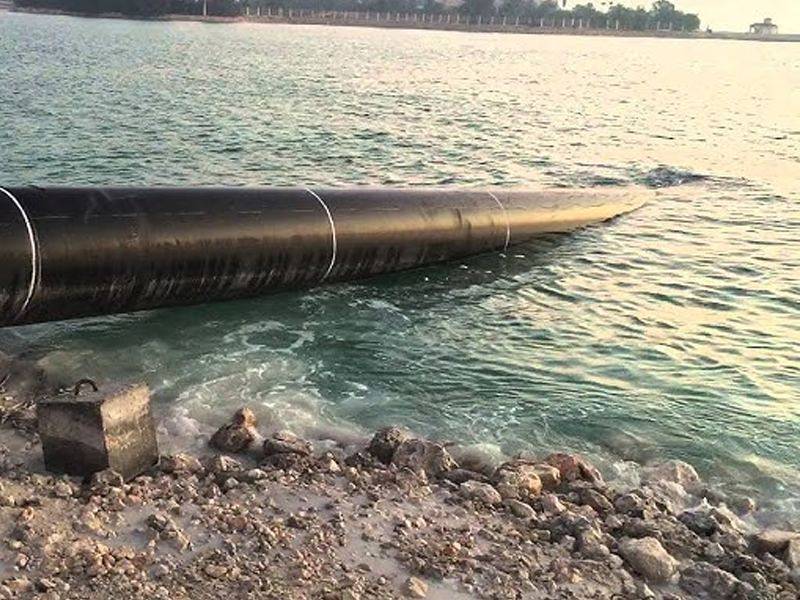
Jetty piping, seawater intake lines and outfall lines use immersion-grade coatings to resist seawater corrosion and splash zone wear.
Pipe Coating Cost in India
Work prices per square metre of coated area, and 200 square metres is where the order book opens. Pipe coating price moves with the specification rather than the metre, so an identical length prices differently once the system and its standard are settled. Six variables shift a quotation:
- The system specified, since a three layer build carries several times the material of a single epoxy film
- Coated area, which follows from outside diameter and total length
- Thickness and standard called for in your project document
- Substrate condition, since rusted pipe absorbs preparation that new pipe does not
- Component geometry, because a bend or a flange occupies a crew longer than an equal area of barrel
- Where the work is carried out, whether pipe comes to our factory or our crew works at your site
Quote us the full schedule rather than one line item and the rate reflects the whole scope.
Why Choose Radisson Impex for Pipe Coating
Five things separate a coating contractor worth shortlisting from one worth passing over, and our pipe coating services are built around all five.
- Every external and internal system on this page comes from one contract, so a project running 3LPE on the barrel, concrete on a crossing and potable water epoxy on the bore deals with one party throughout.
- Flanges, bends and fittings are coated to the project specification, with a system compatible with the coating on the straight barrel.
- Pipe already in service can be recovered to bare metal and recoated, which allows suitable existing pipe to be prepared and recoated where the project permits reuse.
- Your project document sets thickness, preparation grade and the test regime, and no house standard is put in front of it.
- Coating runs at our factory or at your project site, which is what our onsite capability was built for.
Pipe Coating: Frequently Asked Questions
What is Pipe Coating?
Pipe Coating is a bonded protective layer applied to Steel Pipe to shield the metal from corrosive electrolytes. External systems protect the outer wall from aggressive soil and moisture, while internal linings safeguard the pipe bore against corrosive conveyed fluids.
What are the main types of Pipe Coating?
The main families include Three-Layer Polyolefin systems like 3LPE Coating and 3LPP Coating, single and dual-layer Fusion Bonded Epoxy Coating, specialised Liquid Epoxy formulations, Coal Tar Tape and Cold Applied Tape wraps, Concrete Weight Coating, and Cement Mortar Lining.
What is 3LP Coating?
3LP Coating refers to a Three-Layer Polyolefin system featuring an outer extruded polyolefin jacket, an intermediate copolymer adhesive, and a Fusion Bonded Epoxy primer bonded to the steel. Using a polyethylene topcoat forms 3LPE Coating, while a polypropylene topcoat forms higher-temperature 3LPP Coating.
How do I choose between coating systems?
Selection depends systematically on whether the pipeline is buried or aboveground, its maximum operating temperature, internal versus external exposure, handling and installation severity, potable water compatibility requirements, and governing client engineering specifications.
Can you coat the inside of a pipe?
Yes. We apply internal FBE and potable-grade liquid epoxy to bores from 3" to 200", and cement mortar lining from 4" upward in line with AWWA C205, matching the lining to your conveyed fluid and operating temperature.
Which pipe sizes and materials do you coat?
We coat external diameters from 1" to 200" and internal bores from 3" to 200" across Mild Steel Pipe, LTCS Pipe, and Alloy Steel Pipe, accommodating Seamless Pipe, ERW Pipe, LSAW Pipe, and Spiral Welded Pipe up to 18 metres in length.
Do you coat fittings, bends, and flanges?
Yes. We coat fittings, bends and flanges using a system compatible with the straight-pipe coating, to the thickness your specification sets, with full inspection documentation.
Can old or rusted pipe be re-coated?
Yes. We regularly refurbish weathered or used Steel Pipe by stripping old coatings, shot blasting the steel to Sa 2½ or the grade your specification sets, and applying a fresh, fully tested Pipe Coating system.
Which pipe coating standards do you work to?
We work to major international and Indian standards including ISO 21809-1 and IS 15659 for Three-Layer Polyolefin, ISO 21809-2 for Fusion Bonded Epoxy, ISO 21809-5 for Concrete Weight Coating, and relevant AWWA C-series standards for Liquid Epoxy, Tape Coating, and Cement Mortar Lining.
What materials are commonly used for pipe coating?
Common materials include thermoset powders like Fusion-Bonded Epoxy (FBE), liquid epoxies, and multi-layer polyolefins such as Three-Layer Polyethylene (3LPE) and Three-Layer Polypropylene (3LPP). Other specialized systems utilize cold-applied polyolefin or coal tar tapes, cement mortar, and concrete weight coatings depending on internal media and burial conditions.
How does pipe coating affect corrosion resistance?
Pipe coating creates an impermeable physical barrier that isolates the steel substrate from external electrolytes, moisture, and aggressive soil chemistry. By interrupting the electrochemical circuit necessary for rust and pitting to form, it minimizes current demand for cathodic protection systems and prevents structural metal loss over decades of continuous service.
Send Your Pipe Schedule and the Governing Specification. Name the diameter, the quantity, the system and the standard your project runs to, and you'll have scope, timing and a rate back against the pipe coating services you need.