
Polyolefin tape coating is a cold-applied external system made by winding layers of tape onto the pipe. A liquid primer goes onto the prepared steel first, followed by an inner tape for corrosion protection and an outer tape for mechanical protection during handling, lowering-in and contact with backfill. No curing reaction is required, so backfilling can proceed as soon as the specified layers are complete. The coated area should not, however, bear loads from supports or lifting equipment.
At Radisson Impex, we supply polyolefin tape coating for steel pipes, flanges, bends and fittings. Established in 2012, we hold ISO 9001 certification for our quality management system. Polyolefin tape systems are specified for seamless, ERW, LSAW and spiral-welded steel pipe in mild steel, LTCS and alloy steel.

Polyolefin Tape Coating Service Options
Branded polyolefin tapes, supplied pan-India.
-
Supplied to you
Tape Supply
- Branded tapes
- Quoted to your specification
The Polyolefin Tape System
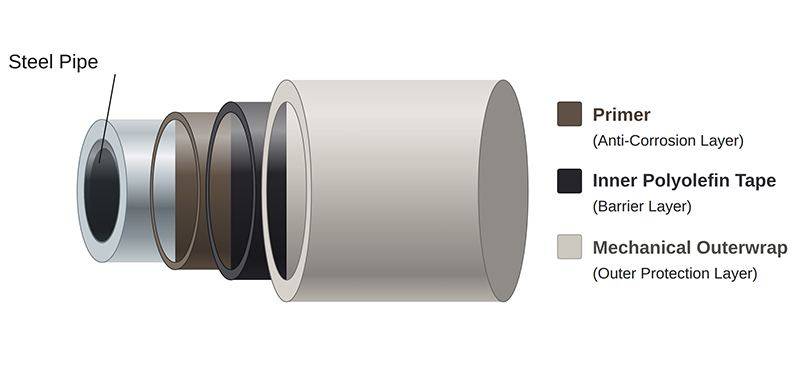
A typical polyolefin tape system comprises three components: primer for adhesion to steel, an inner corrosion-protection tape, and an outer mechanical-protection tape. Two-component systems (primer and inner tape) and three-component systems (primer, inner tape and outer wrap) are both written into live specifications.
-
Primer
Primer forms the bond between the prepared steel and inner tape, and the specified primer must be compatible with the tape system. The liquid grade brushes or sprays onto prepared steel, flashes off, and leaves a surface the inner tape's adhesive can key into. Where required, compatible mastics or profiling materials are used to smooth irregular surfaces before wrapping. Every series carries a primer matched to its own adhesive chemistry, so pairing one brand's primer with another brand's tape is a specification error rather than a saving.
-
Inner Corrosion Tape
The inner tape does the corrosion work. A malleable polyethylene backing carries a heavy-duty adhesive that stays conformable across a wide temperature range while resisting shear in the ground, and that adhesive layer is what shuts soil moisture out. Backing thickness and adhesive thickness both appear on the data sheet for the series. Where a tender specifies PE tape, the exact product construction should be confirmed against the material specification and approved data sheet.
-
Outer Mechanical Wrap
The outer wrap adds mechanical protection in the trench and weathering protection to the system. A tougher backing used in polyolefin coating systems carries a lighter adhesive over the inner tape, taking stone loading, drag during lowering-in, and abrasion from rocky backfill. Polypropylene tape coating gets specified for this layer where a project wants a harder outer film than polyethylene delivers, and PP tape appears in tender wording for the same reason. Lines bedded in soft screened sand sometimes take a two-component system with no outer wrap.
Polyolefin Tape Coating Specifications
The table sets out the pipe sizes, substrates and system components typically covered by polyolefin tape coating specifications.
| Parameter | Scope |
|---|---|
| Coating system | Liquid primer with inner corrosion tape and outer mechanical wrap (IS 18910 Type A, pipe up to 1400 mm OD). For pipe of 1400 mm OD and above, an intermediate mechanical tape is added between inner and outer tape (IS 18910 Type B). Primer with inner tape only where the specification allows a two-component system. |
| Pipe types accepted | Seamless, ERW, LSAW, spiral welded (HSAW) |
| Substrates accepted | Mild steel (MS black), LTCS, alloy steel |
| Line pipe | API 5L line pipe, Grade B through X120 |
| Components covered | Straight pipe, flanges, fittings, bends |
| Substrate condition | New pipe and previously coated pipe prepared to the specified condition |
| Outside diameter range | 1 inch to 200 inches |
| Maximum pipe length | 18 metres |
| Maximum weight per pipe | 24 tonnes |
Polyolefin Tape Coating Standards
The governing project standard defines the tape class, overlap and acceptance criteria. The table lists the standards most often referenced for polyolefin tape coating. Your project specification decides which one applies.
Country / Region / Designation / Standard title and scope
- USA (AWWA)
- AWWA C209-25Hand-Applied Tape Coatings for Steel Water Pipe and Fittings. Coatings under this standard go on in the field or in a shop without heat, either over bare pipe and fittings or as a joint coating over an organic coating already in place. The title has changed several times: "Cold-Applied Tape Coatings for the Exterior of Special Sections, Connections, and Fittings for Steel Water Pipelines" up to the 2007 edition, "Cold-Applied Tape Coatings for Steel Water Pipe, Special Sections, Connections, and Fittings" in 2013, and "Tape Coatings for Steel Water Pipe and Fittings" in 2019.
- USA (AWWA)
- AWWA C214-24Machine-Applied Polyolefin Tape Coatings for Steel Water Pipe. Covers prefabricated polyolefin tape applied in coating plants at fixed sites, as a three-layer build of liquid adhesive, inner corrosion-preventive tape and outer mechanical-protective tape. The 2014 edition was titled Tape Coatings for Steel Water Pipe, and earlier editions were titled Tape Coating Systems for the Exterior of Steel Water Pipelines.
- Europe (EN)
- EN 12068:1998, issued in Britain as BS EN 12068:1999Cathodic protection. External organic coatings for the corrosion protection of buried or immersed steel pipelines used in conjunction with cathodic protection. Tapes and shrinkable materials. Classifies coatings by increasing mechanical resistance and by permitted operating temperature
- International (ISO)
- ISO 21809-3:2016, with Amendment 1:2020Petroleum and natural gas industries. External coatings for buried or submerged pipelines used in pipeline transportation systems. Part 3: Field joint coatings. Tape wrapped at 50 per cent overlap counts as a two-layer coating under this document. Amendment 1 introduced mesh-backed systems, and a revision is in draft as ISO/DIS 21809-3
- Germany (DIN)
- DIN 30672-1:2019-05 and DIN 30672-2:2019-05Field coating materials for corrosion protection of buried pipelines. Part 1 covers requirements and product testing, Part 2 covers application and quality control on site. The 2019 editions of both parts replaced DIN 30672:2000.
- India (IS)
- IS 18910:2024Cold-applied (polyethylene/polyolefin) tape coating for mild steel water pipelines. Specification
IS 15337 is sometimes cited in tape coating enquiries, but it covers coal tar based anticorrosion tape, not polyolefin tape.
Features and Benefits of Polyolefin Tape Coating
Five practical advantages of a wrapped polyolefin tape system.
-
Backfill can follow straight away. There is no melt point, cure time or cooling period to wait out, though coated sections should be kept clear of supports and lifting slings.
-
Non-conventional shapes are not a problem. Wound material conforms to a reducer, an elbow or a bend, so irregular components get the full build.
-
Repairs use the coating itself. Damage found later is made good with the same material by hand, without a booth or an oven.
-
The build can vary along the route. Overlap and ply count can be varied by project requirement, allowing sections exposed to abrasive backfill to receive additional protection.
-
The system needs no fusion or curing cycle, which simplifies recoating work, although preheating may be needed in cold conditions.
Polyolefin Tape Coating Process
Polyolefin tape systems are applied in the sequence below. Specified performance depends on compliance with the surface-preparation, application, and inspection requirements.
-
Surface Preparation Requirements
Surface preparation comes ahead of everything else, to the grade named in the governing specification and the series data sheet. Where the coating is blast cleaned, the standard grade is Sa 2½ to ISO 8501-1. This is the level IS 18910:2024 requires. Power-tool cleaning to St 3 is used only where the project specification and the tape data sheet both allow it. Oil and grease are removed first by solvent cleaning. The steel is then cleaned to remove loose mill scale, rust and dust. Where the surface is blasted, the anchor profile is held between 50 and 75 µm, measured by replica tape to ISO 8503-5, or as the tape data sheet specifies.
-
Primer Application Procedure
Primer follows the cleaning, applied evenly to a dry film thickness of 50 to 75 µm, and the tape goes on only once the primer is dry to the touch. Applying tape before the primer reaches the specified application condition can reduce adhesion and contribute to premature disbondment.
-
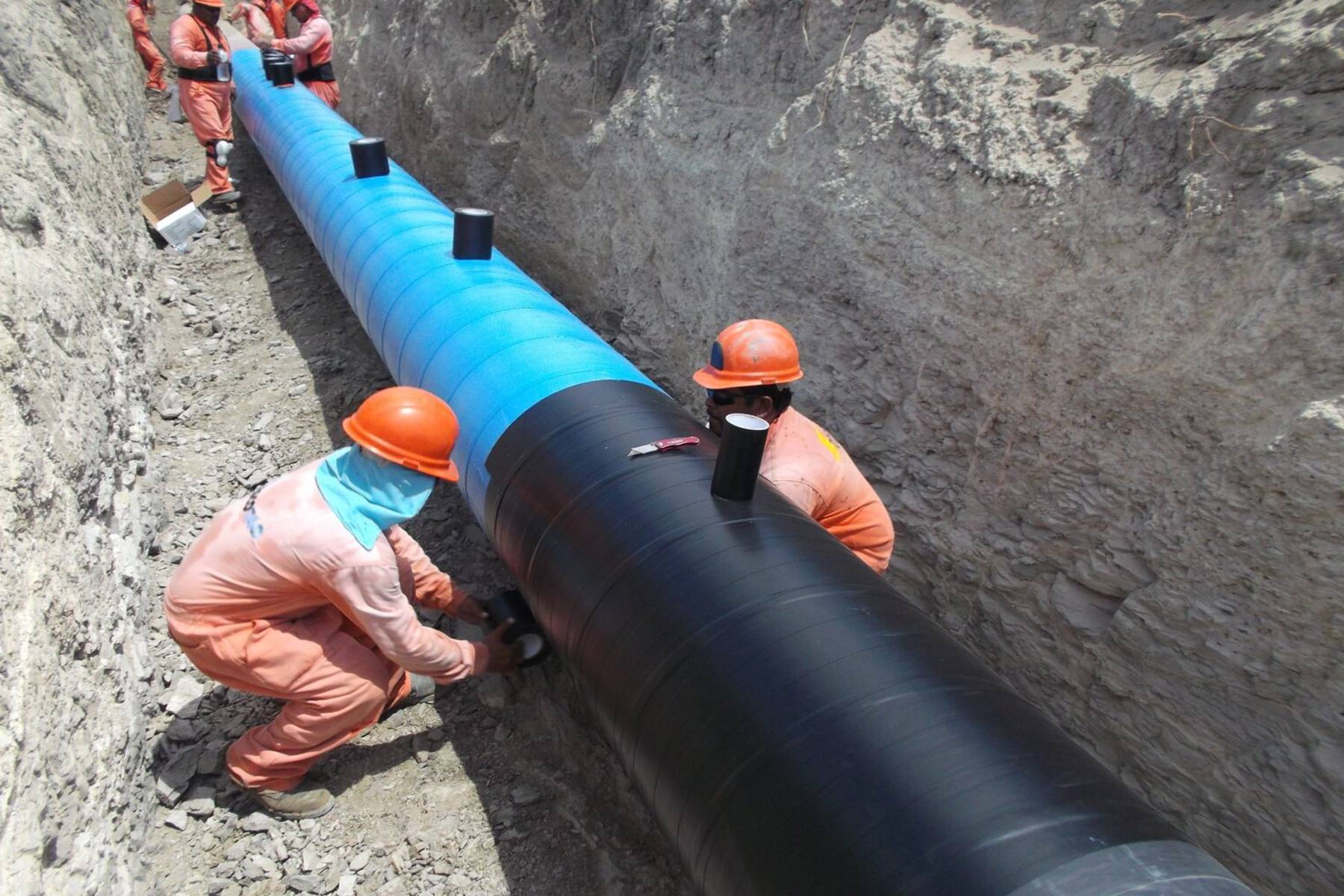
Inner Tape Spiral Wrapping
The inner tape goes on in a spiral at the overlap named in the specification. Wrap tension should follow the ideal application procedure so the tape conforms to the pipe surface without excessive stretching. A single tape wrapped at 50 per cent overlap puts two tape thicknesses over every point of the pipe, which is why overlap percentage and layer count get confused in tender wording so often. Confirm how your specification counts layers before quoting.
-
Outer Wrap and Irregular Component Application
The outer wrap follows the same spiral discipline, laid over the inner tape with the laps staggered so that inner and outer overlaps do not fall on the same line, as IS 18910:2024 requires. Fittings, flanges, bends and short irregular sections take narrower rolls, moulded into shape by hand.
Tape Thickness and Performance
Tape build, overlap and service temperature are established by the project specification and the approved tape system. The coating is built to the specified thickness and overlap in line with the manufacturer's application procedure.
Total Build Thickness
The finished coating build depends on the tape construction, number of layers and specified overlap. A specification may define a minimum total thickness, a number of plies, or both, together with the required overlap. The finished build is verified against the applicable specification and product data sheet.
Service Temperature
Service temperature limits depend on the adhesive, backing and construction of the selected tape system. EN 12068 classifies external organic coatings according to mechanical resistance and permitted operating temperature. The applicable temperature limit therefore comes from the specified coating class and the manufacturer's data sheet rather than a general temperature range. The tape system is selected against the service conditions stated in the project specification.
Adhesion and Cathodic Disbondment
Adhesion between the primer, tape and steel helps maintain the barrier at laps and interfaces, while cathodic disbondment resistance limits coating separation around areas exposed to cathodic-protection current. The applicable test requirements and acceptance values depend on the specified tape system and governing standard. Product data and test certificates for the approved system support the project submittal.
Send Us Your Pipe Schedule for a Coating Quote
Send your pipe schedule, coating specification, diameters and quantities for a project quotation.
Testing and Inspection
Finished wrap quality is verified through the inspection checks specified for the tape system, including holiday detection, adhesion, build, overlap and tension.
-
Holiday detection
An electrical sweep finds pinholes and discontinuities through the wrap, and any discontinuity it registers is made good and re-swept before acceptance.
-
Adhesion
Peel resistance is checked at the tape edges and at transitions onto fittings, where lifting starts if the tension is wrong.
-
Applied build
Total thickness is confirmed against the tape class and ply count in your specification.
-
Overlap and tension
These decide whether a wrap performs, so they are set before wrapping starts and watched during it.
Industrial Applications of Polyolefin Tape Coating
Polyolefin tape wrap turns up on four kinds of scope in India, three of which involve pipe already fabricated, already buried, or too irregular for a coating plant.

Oil and Gas Pipelines
Cross-country crude, product and natural gas lines use tape at field welds, hot bends, valve stations and road crossings where the specification calls for it. City gas distribution networks wrap smaller diameter steel the same way, and tape also covers sections re-laid after a diversion.

Water and Wastewater Mains
Steel water transmission mains and sewage rising mains can use Polyolefin Tape for Steel Water Pipes on special sections, connections, and fittings, which is the ground AWWA C209 was written for. Tape also suits the steel pipework inside chambers and at thrust blocks.
Petrochemical and Plant Piping
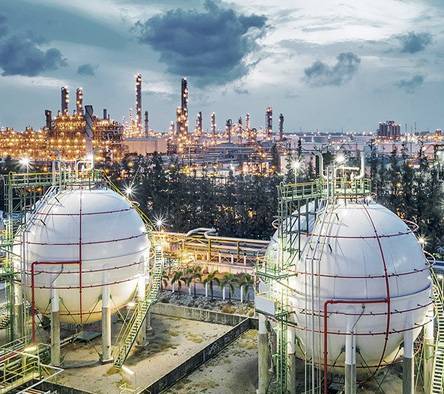
Fire-fighting mains, cooling water headers and buried process lines inside a plant boundary carry more fittings per metre than any cross-country route. Congested routing and short spool lengths suit on-site wrapping, so the wrap handles the geometry.

Rehabilitation of Existing Pipelines
Tape coating is widely used to rehabilitate existing lines. Old, used or rusted pipe can be cleaned, inspected and re-wrapped, returning sound steel to service.
Polyolefin Tape Compared With Other External Systems
Tape, jacket and sleeve solve the same problem by different means, and the choice usually comes down to geometry, temperature and what the specification names. The table given below shows the comparison between Polyolefin tape, 3LPE coating, and heat shrink sleeves.
| Factor | Polyolefin tape | 3LPE jacket | Heat shrink sleeve |
|---|---|---|---|
| Applied | Cold, wound on | Hot, extruded | Heat recovered |
| Best on | Fittings, rehabilitation, varied routes | Straight mainline | Girth welds and joints |
| Service ceiling | Ambient and moderate | Typically up to 80 °C, depending on coating class | Set by the sleeve grade |
| Repair | Same material, by hand | Patch or sleeve | Replacement sleeve |
Cost of Polyolefin Tape Coating
Quotations are based on pipe dimensions, coating build, overlap, quantities and the specified tape system. There's no single price list, because the same metre of pipe consumes a different amount of tape once overlap, layer count and diameter are settled. The main quotation variables are:
- Pipe outside diameter and the total wrapped length, which together set the surface area
- Overlap percentage and layer count, since a 50 per cent spiral consumes twice the tape of a butt wrap
- Roll width and gauge, both following from the series, the specification allows
- Primer type and coverage rate, quoted per litre
Why Choose Radisson Impex for Polyolefin Tape Coating
Key reasons to use our polyolefin tape coating for pipelines:
- Branded polyolefin tapes quoted to your specification.
- Primer and tape supplied as a matched system, so adhesive chemistry and primer stay compatible.
- Supply pan-India to project schedules and tender requirements.
- Working since 2012 under an ISO 9001 quality management system.
Polyolefin Tape Coating: Frequently Asked Questions
What is Polyolefin Tape Coating?
It is a cold-applied external barrier built from a liquid primer, an inner Corrosion Tape, and an outer Mechanical Tape, spirally wound onto Steel Pipe under controlled tension and specified overlap.
What does Tape Coat mean on a specification?
It indicates that the Steel Pipe is protected by spirally wound protective layers rather than a plant-extruded film, requiring the project specification to define the tape class, spiral overlap, and total ply count.
Which standards do you work to?
Supply is matched to the standard and class named in your project specification, such as AWWA C209, EN 12068 or DIN 30672. The class, for example B30 or C50, is confirmed against the manufacturer's data sheet and test certificate. Where a project names IS 18910:2024, compliance is confirmed against the approved data sheet.
What is AWWA C209?
AWWA C209 is the standard for cold-applied Tape Coating systems applied manually to Steel Water Pipe, special sections, and fittings, whereas AWWA C214 covers machine-applied tape systems installed within a coating facility.
What overlap does a Polyolefin Tape System need?
Overlap follows the project specification. Some specifications give it as a percentage of tape width, such as 50 per cent, and others give a minimum lap in millimetres.
Can tape be applied to bends and fittings?
Yes. Induction bends and tees take narrower conformable rolls, with compatible mastic filler on irregular surfaces, to reach the ply count in the specification.
Can old pipe be re-wrapped?
Yes. Rehabilitation involves stripping the degraded coating, blast cleaning back to Sa 2½ and applying a fresh tape system.
Contact us for polyolefin tape supply. Send the schedule and the specification, and we'll come back on availability and price.