
Glass flake epoxy coating is a high-build liquid epoxy loaded with thin, plate-shaped particles of glass. The flakes settle roughly parallel to the steel as the wet film levels, and they overlap through the depth of the coat. Water, oxygen and dissolved salts cannot then travel straight down to the base material. Because water and chemicals must navigate around overlapping glass flakes, they travel a much longer path through the coating without increasing its actual thickness. Reinforcement makes the coating stiffer, protects welds and sharp edges, and absorbs harsh wear that would otherwise expose bare metal.
Radisson Impex applies glass flake epoxy to steel pipe, fittings and flanges. Our company was established in 2012 and holds ISO 9001 certification. For external work, we handle pipes ranging from 1 to 200 inches in outer diameter, up to 18 meters long, and weighing up to 24 tonnes each, across mild steel, LTCS, GI, carbon steel and alloy steel, including API 5L line pipe in Grade B through X80 (and higher grades such as X100/X120 where supplied). Surface preparation is abrasive shot blasting to Sa 2½ on bare steel, with a light sweep blast on GI so the zinc layer stays in place. The majority of our clients are EPC contractors and government tender projects.
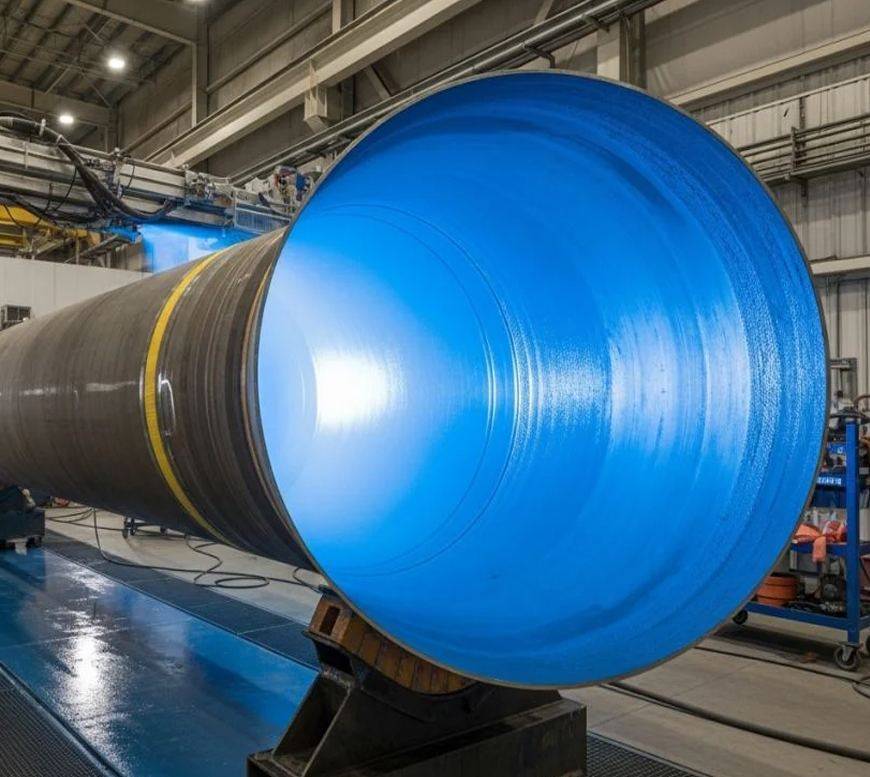
Glass Flake Epoxy Coating Service Options
Applied at our Vasai factory.
-
At our facility
Factory coating
- Vasai factory
- Pipe transport arranged
The Glass Flake Epoxy System Explained
The performance of glass flake-reinforced epoxy on steel depends on several factors, including the two-component binder, the dispersed glass flake, the barrier geometry formed by the cured film, and the coating type selected. Coating engineers shorten the family to GFE, or glass flake epoxy.

-
The Two-Component Epoxy Binder
The binder is a liquid epoxy resin cross-linked by a separate curing agent, and the two parts are mixed shortly before work begins. Amine and polyamide curing agents are the common choices, and whichever a formulator selects governs chemical resistance, cure behaviour and final hardness. Most glass flake epoxies use an amine curing agent. The binder carries adhesion to the blasted steel and holds every platelet in position.
-
Lamellar Glass Flake Reinforcement
Glass flake is added to the coating as thin platelets, not as fibres or granules, and this shape is what gives it its reinforcing effect. Two glass types are used in anticorrosion coating. C-glass is the chemically resistant type, formulated to hold up in acidic media, and it's the usual selection for anticorrosion duty. ECR-glass (extra chemical resistant) is formulated for coatings that need even higher chemical resistance. E-glass, the electrical grade, is used mainly to reinforce plastics and composites. Glass flakes are inert. They don't corrode, absorb moisture or swell with humidity, and the chemically resistant grades hold up well in service.
-
How the Barrier Works
An unfilled epoxy resists permeation by film thickness alone. Overlapping flake changes that geometry completely: a water molecule entering the surface meets an impermeable platelet, travels sideways to its edge, then meets another, and repeats the detour many times before it reaches steel. Path length grows while the build stays constant. Reduced permeation slows water and oxygen on their way to the metal, reducing osmotic blistering during immersion. The same overlap resists sideways creep of corrosion from a scribe or a holiday. A glass flake reinforced epoxy coating therefore outperforms an unfilled film of equal thickness, and that is why it gets specified where an ordinary high build would be marginal.
-
Types of Glass Flake Epoxy We Apply
Three coating types cover almost every enquiry we receive. High-build glass flake epoxy delivers the greatest film build per coat and suits external steel in atmospheric and splash zone service. Solvent-free glass flake epoxy is the immersion and lining type, chosen where solvent trapped inside a thick film would itself become a defect; a glass flake epoxy lining on the bore of a water main is the routine case. Glass flake epoxy mastic is surface tolerant, formulated to bond to steel cleaned by hand or power tool rather than by blasting. The types overlap in practice, since most solvent-free products are also high-build, so we apply whichever product your specification names.
Glass Flake Epoxy Coating Specifications
The table sets the scope of what we coat and supply, and it answers most of what a buyer checks a glass flake epoxy data sheet for.
| Parameter | Scope |
|---|---|
| Coating system | Two-component glass flake-reinforced epoxy, applied as a liquid |
| Coating types applied | High-build, solvent-free for immersion and lining, surface-tolerant mastic |
| Coating materials | Liquid epoxy products or the system named in your specification |
| Pipe types accepted | Seamless, ERW, LSAW, spiral welded (HSAW) |
| Substrates accepted | Mild steel (MS black), LTCS, alloy steel, GI and carbon steel |
| Line pipe | API 5L line pipe, Grade B through X80 (and higher grades such as X100/X120 where supplied) |
| Components coated | Straight pipe, flanges, fittings, bends |
| Substrate condition | New pipe, plus cleaning and re-coating of old, used or rusted pipe |
| Outside diameter range | 1 inch to 200 inches for external coating; 3 inches to 200 inches where the coating goes on the bore |
| Maximum pipe length | 18 metres |
| Maximum weight per pipe | 24 tonnes |
| Surface preparation | Abrasive shot blasting to Sa 2½ on bare steel; light sweep blast on GI (galvanised) surfaces |
| Coating thickness | Applied to the dry film thickness stated in the customer specification |
Glass Flake Coating Standards
This section outlines the applicable standards and designations for glass flake coatings, which are governed by the relevant protective paint system framework rather than a standalone specification.
Country / Region / Designation / Standard title and scope
- International (ISO)
- ISO 12944-1:2017Paints and varnishes. Corrosion protection of steel structures by protective paint systems. Part 1: General introduction. The series covers carbon steel structures of not less than 3 mm thickness
- International (ISO)
- ISO 12944-2:2017Part 2: Classification of environments. Sets the atmospheric corrosivity categories C1 to CX and the water and soil categories Im1 to Im4
- International (ISO)
- ISO 12944-5:2019Part 5: Protective paint systems. Current edition, which replaced ISO 12944-5:2018
- International (ISO)
- ISO 12944-9:2018Part 9: Protective paint systems and laboratory performance test methods for offshore and related structures. It cancels and replaces ISO 20340:2009
- Norway (NORSOK)
- NORSOK M-501, Edition 7 (2022)Surface preparation and protective coating. System 1 covers exterior atmospheric structural steel; System 7 covers splash zone (7A) and submerged steel (7B and 7C). Edition 7 superseded Edition 6 of 2012
- USA (AMPP, formerly NACE)
- NACE SP0108-2008Corrosion Control of Offshore Structures by Protective Coatings
- International (ISO)
- ISO 8501-1:2007Preparation of steel substrates before application of paints and related products. Visual assessment of surface cleanliness. Part 1: Rust grades and preparation grades. The Sa 2½ grade comes from this document
- India (IS)
- IS 9954 : 1981Pictorial Surface Preparation Standards for Painting of Steel Surfaces
Features and Benefits of Glass Flake Epoxy
Flake reinforcement delivers direct financial returns on demanding projects. These five engineered features cut long-term maintenance costs while reducing critical operational risks.
-
Permeation resistance that build alone cannot buy
Doubling the thickness of a plain epoxy roughly doubles the diffusion path. Flake multiplies it, so the same protection arrives without stacking coat after coat.
-
Abrasion and impact tolerance
Glass in the film takes wear that would otherwise reach the resin. Backfill against stone, tidal debris and slurry contact is where this shows up first.
-
Edge retention
Liquid coatings thin out on weld caps, flange faces and sharp corners as they flow. A reinforced film holds more build there, and edges are where premature failure starts.
-
Surface-tolerant grades for steel that cannot be blasted
Surface-tolerant mastics for steel that cannot be blasted: Where a specification permits hand or power tool cleaning, a mastic product bonds to that surface instead of demanding a blast profile it won't get.
-
Dimensional stability under thermal movement
Glass expands far less than the resin around it, so a reinforced film builds less internal stress across a heating and cooling cycle.
Glass Flake Coating Application Process
Our sequence runs in four stages: blast the steel, mix the two components, build the film to the specified thickness, then cure, inspect and release. Fittings, bends and flanges are coated manually, so complex geometry receives the same system as straight lengths.
-
Surface Preparation to Sa 2½
Abrasive shot blasting takes the substrate to Sa 2½, the near-white grade defined in ISO 8501-1. Mill scale, rust and any previous coating come away, and the blast profile gives the epoxy a mechanical key. Preparation grade is the largest single control on coating life, so we inspect the blasted surface before the painting begins.
-
Mixing and Film Build
Base and curing agent go together in the ratio the product data sheet states, and pot life starts at that moment. Glass flake coating application then builds the wet film that will deliver your specified dry thickness once the resin cures. Flake orientation happens as the film levels, with flakes settling parallel to the substrate. That alignment is the geometry the whole barrier depends on. We strictly adhere to the overcoating intervals specified in the product data sheet, rather than adjusting them to match work shift schedules.
-
Cure, Inspection and Release
Cured film gets checked before anything leaves our control. We record dry film thickness readings, holiday results, adhesion figures and cure state against the job, and any discontinuity found is repaired and re-tested. The documentation package travels with the pipe.
Epoxy Glass Flake Coating Thickness and Performance
Project engineering documents dictate the target dry film thickness for glass flake epoxy coatings. Three key factors stem directly from this specification.
Specified Dry Film Thickness
Your specification sets the thickness per coat and as a total. We don't publish one company-wide dry film thickness range for this system because coating type, coat count and corrosion category all move the figure, and imposing a house number over your document would put the coating out of compliance.
Barrier and Abrasion Behaviour
An epoxy glass flake coating earns its place on two counts. Permeation resistance is the first, and it comes from flake geometry rather than from resin chemistry. Abrasion resistance is the second, which matters on backfilled lines, tidal steel and anything handling solids. Chemical and temperature limits sit with the product you specify, so we take those from its data sheet.
The Rigidity Trade-Off
Glass flake stiffens the film it reinforces. Elongation falls as reinforcement rises, and an over-applied film cracks under substrate flexure more readily than a correctly specified one. Thickness therefore has to be chosen deliberately instead of maximised.
Send Us Your Glass Flake Epoxy Coating Schedule for a Coating Quote
ISO 9001 certified coating operations, running from Mumbai since 2012 with pan-India execution. Factory photos, video of live application and a sample test certificate are available on request.
Glass Flake Epoxy Testing and Inspection
Four essential quality checks verify coating performance before dispatch, catching potential defects early to ensure full project compliance.
-
Dry film thickness (DFT)
We take readings across the coated surface and compare each one against the thickness your specification states.
-
Holiday or spark testing
A spark probe sweeps the cured surface at the voltage your specification sets, and every pinhole or void it registers is made good and re-swept before the length is signed off.
-
Adhesion or pull-off testing
A dolly is bonded to the film and pulled until it separates, and the recorded force tells you whether the coating will stay put once the item is lifted and installed.
-
Cure
testing. Cure is confirmed before despatch, because an under-cured film has not yet reached the hardness and chemical resistance the data sheet promises.
Where your contract puts a resident inspector or a nominated agency on the work, we accommodate them. The signed test record and coating report leave with the consignment.
Glass Flake Epoxy Coating Industrial Applications
Glass-flake epoxy is used in steel sitting in wet, salty or abrasive service, and onto the fittings installed with it. Four groups account for most of the glassflake work we handle.

Offshore and Marine Splash Zone Steel
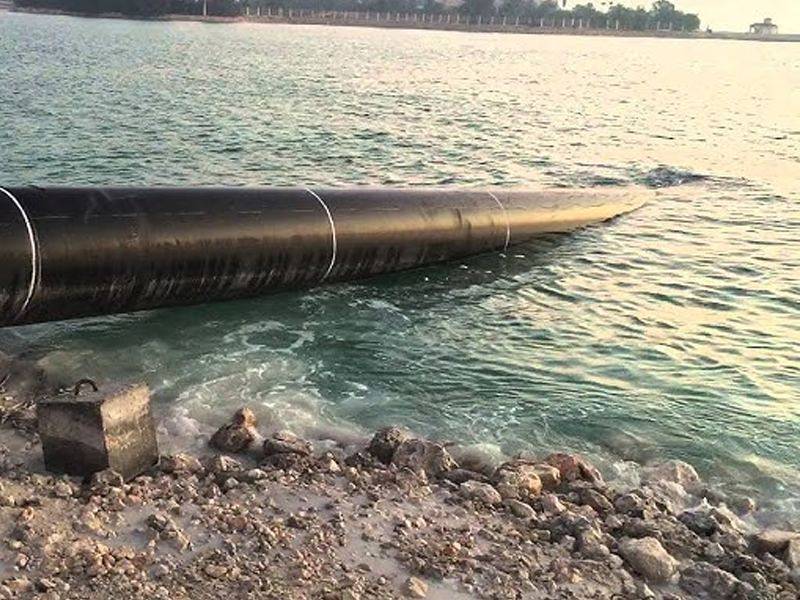
Splash zone steel takes the harshest exposure on a marine structure: alternating wetting and drying, full oxygen availability, salt and wave impact together. A glass flake epoxy splash zone coating is the standard choice because barrier performance and abrasion resistance are both needed at once. Risers, caissons, jetty piles and the pipework running with them sit in that band.
Buried and Submerged Pipelines
Buried steel meets soil chemistry that changes along the route, plus mechanical loading from backfill. Below the water table, continuous contact is where a thin unreinforced film fails first. On these lines, the system is one option within our external pipe coating range, and selection depends on soil aggressiveness, operating temperature and how much handling the pipe takes.
Water and Wastewater Treatment Plant
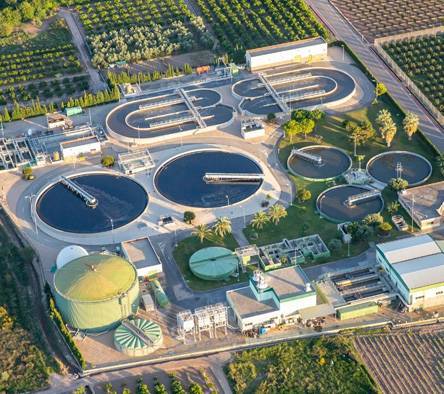
Treatment plants combine immersion, humidity and aggressive chemistry in a small footprint. Clarifier steelwork, penstocks, screens and process pipework all sit in that mix. Where the coating goes on the bore instead of the outside, the job runs as internal pipe coating.
Chemical, Power and Process Plant Steelwork
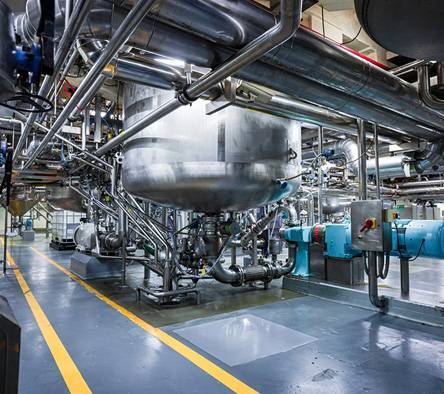
Process plant brings acid and alkali splash, condensate, and tightly packed pipework that puts more fittings per metre into a scope than a cross-country line does. Cooling water systems, fire-fighting mains and chemical transfer lines are the usual candidates. Coated bends and flanges matter more here than on a straight run, because that is where film build is hardest to hold.
Glass Flake Epoxy vs Other Epoxy Coating Systems
Choose glass flake where barrier performance and abrasion resistance decide the job: immersion, splash zone, buried steel and solids-handling duty. Phenolic can be selected where solvent and chemical immersion at temperature govern. We apply all of them, so the table is a selection guide.
The difference from phenolic epoxy coating is the resistance being bought: epoxy phenolic and epoxy novolac products are built for solvents and hot chemical immersion. Amine-cured describes how an epoxy hardens, not a separate coating family. Most glass flake epoxies are amine-cured too, so the last column shows the same kind of film without flakes.
| Factor | Glass flake epoxy | High-build epoxy (unfilled) | Phenolic epoxy |
|---|---|---|---|
| Reinforcement | Lamellar glass flake | None | None |
| Principal strength | Permeation barrier and abrasion resistance | Build at lower cost | Chemical and solvent resistance |
| Cure route | Commonly amine-cured | Amine or polyamide | Phenolic resin (often heat-cured) or amine, depending on the product |
| Edge retention | High | Moderate | Moderate |
| Common use | Immersion, splash zone, buried and abrasive service | General atmospheric steel | Solvent and chemical immersion |
Glass Flake Epoxy Coating Price in India
Coating work is charged per square metre of coated surface, with a minimum order of 200 square metres. There is no single rate, because the price per square metre depends on the steel and the specification. These factors affect the cost:
- Total coated surface area, and the outside diameter it is spread across
- Dry film thickness and the number of coats your specification calls for
- Coating type selected, since solvent-free and mastic products are priced differently from a standard high build
- Substrate condition, because cleaning and re-coating a rusted pipe requires more preparation than new steel
- Component mix, as bends, fittings and flanges take more handling per square metre than straight lengths
- The coating system named in your document, and the test and documentation regime the contract requires
Submit your full project scope to receive a formal, tiered quotation for glass flake epoxy coating.
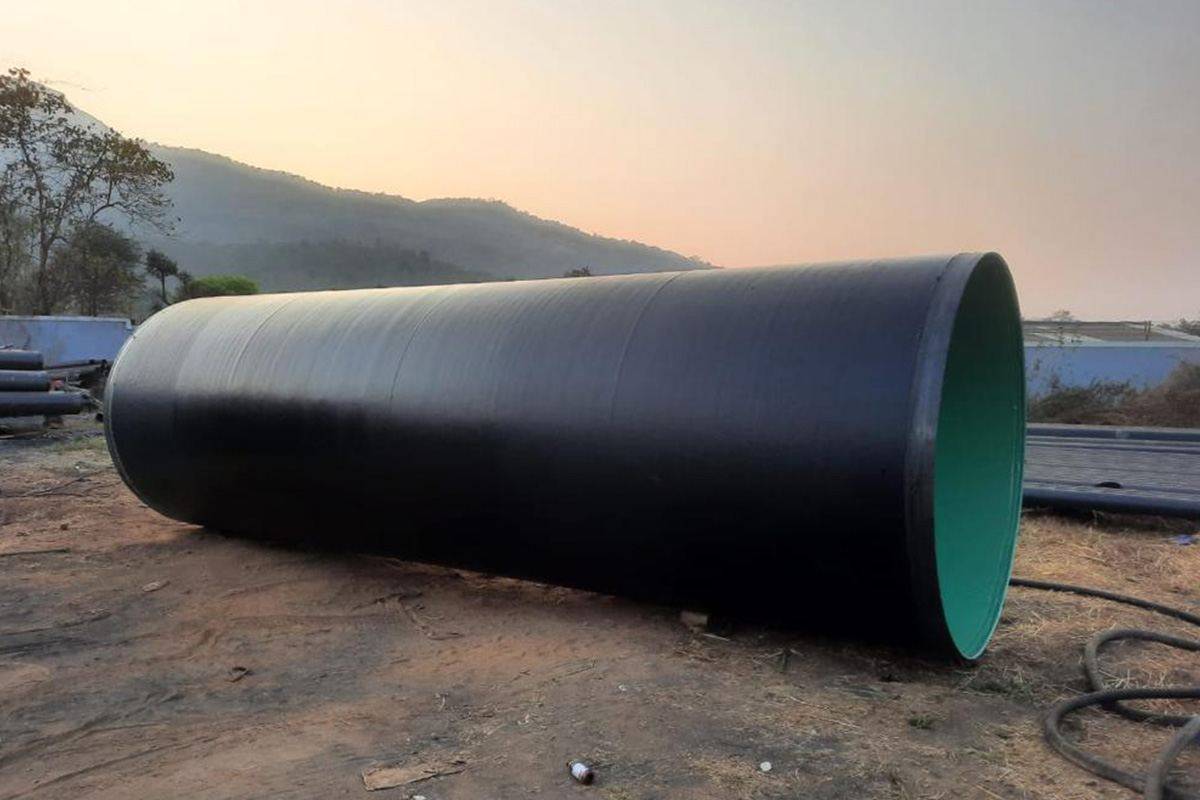
Why Choose Radisson Impex for Glass Flake Epoxy
Choose Radisson Impex for your glass flake coating application to benefit from tailored specifications and proven quality control.
- Fittings, bends and flanges receive the same system as straight pipe, because manual application is not constrained by a fixed line profile.
- An old and rusted pipe can be cleaned back to bare steel and re-coated, keeping sound material in service.
- Preparation grade, film thickness and test regime follow your project document rather than a house standard.
- Every job leaves with its thickness, holiday, adhesion and cure records written up, and outside inspectors are welcome to witness the work.
Frequently Asked Questions
What is Glass Flake Epoxy Coating?
Glass flake epoxy is a two-component liquid coating reinforced with thin glass flakes. The flakes overlap inside the cured film and force water, oxygen and salts along a far longer path before they reach steel. That barrier effect, plus added abrasion resistance, is what a specification is buying.
Can this coating be applied as an internal lining?
Yes, solvent-free products are formulated for immersion, and an internal glass flake epoxy coating on the bore is applied and tested the same way as an external film. Our internal size range runs from 3 inches to 200 inches.
Can you re-coat an old or rusted pipe?
Yes. Cleaning and re-coating of old, used or rusted pipes is established work for us. The existing coating comes off, the substrate goes back to bare steel at Sa 2½, and the new system is applied and tested.
What surface preparation is needed?
Abrasive shot blasting to Sa 2½ is our standard preparation, and ISO 8501-1 defines that grade. Where blasting is impractical and your specification permits it, a surface-tolerant mastic will bond to hand or power-tool-cleaned steel. GI surfaces get a light sweep blast so the zinc stays in place.
Which standard do you work to?
We work to the specification your project supplies. For offshore and marine steel structures, ISO 12944-9 and NORSOK M-501 are common frameworks, and ISO 12944-5 covers paint system selection for the milder categories (not CX or Im4). These standards set system and performance requirements; they do not make glass flake mandatory. Pipelines and buried pipe fall outside ISO 12944-9, so on those jobs we follow the pipeline coating specification named in your contract.
How does Glass Flake Epoxy Pipe coating differ from a plain high-build epoxy?
Both are liquid epoxies, and reinforcement is the difference. Overlapping flake extends the diffusion path and adds abrasion resistance, so the reinforced film outperforms an unfilled one of the same thickness in immersion, splash zone and buried service.
Contact Us for Glass Flake Epoxy Coating. Send your coated surface area, substrate condition, and the specification your project is written to, and we'll confirm scope and quote glass flake epoxy coating.