
External FBE coating is a thermosetting epoxy powder coating applied to the outside surface of a steel pipe. FBE stands for fusion-bonded epoxy, and the name describes what happens on the steel: dry powder lands on a preheated, blast-cleaned surface, melts, flows out and cross-links into a continuous film. External fusion-bonded epoxy coating protects the soil-side face, the one that meets wet backfill, groundwater and stray current for the design life of a buried or submerged line. Those external service conditions determine the coating's performance requirements. External FBE is evaluated for cathodic disbondment, soil exposure and construction damage rather than the internal service conditions of the pipe. Cured epoxy isolates the steel from the electrolyte around it, and it works together with the cathodic protection system, lowering the current the CP system needs and allowing that current to reach the steel at any defect. Project documents may also use EFBE for externally applied fusion-bonded epoxy coating.
Radisson Impex, an ISO 9001-certified coating contractor based in Mumbai since 2012, provides external FBE pipe coating services across India. We coat seamless, ERW, LSAW, and HSAW pipes in mild steel, LTCS, and alloy steel, including API 5L Grades B to X120. Our capacity spans diameters from 1 to 200 inches, lengths up to 18 metres, and weights up to 24 tonnes per piece. Our epoxy range includes single-layer, dual-layer, and protective topcoat systems. We coat straight lengths, bends, fittings, and flanges. Operations feature SA 2½ blasting and specified thickness compliance.
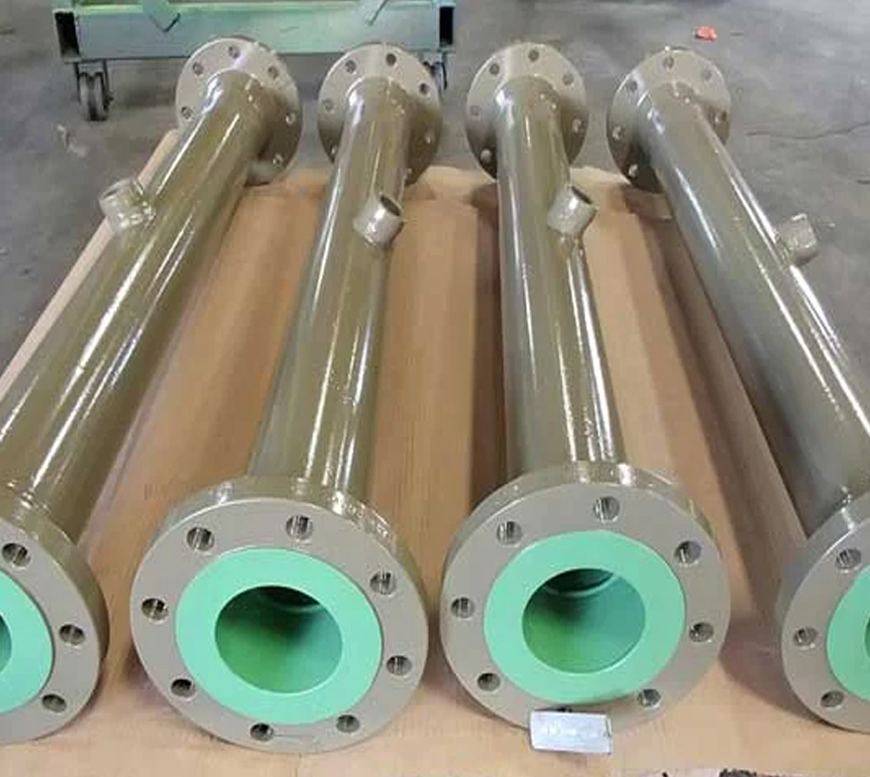
External FBE Coating Service Options
Applied at our Vasai factory, with pipe supplied coated across India.
-
At our facility
Factory coating
- Vasai factory
- Pipe transport arranged
-
At your project site
Onsite coating
- Pan India
- Coated at your project site
-
For existing pipes
Re-coating
- Old, used or rusted pipe
- Stripped, blasted, recoated
The External FBE Coating System
External FBE does two jobs from one film: it isolates the steel electrically, and it holds that isolation while the line sits under cathodic protection for decades. Three factors govern external FBE performance: adhesion to prepared steel, service and construction exposure, and whether the epoxy is used alone or beneath a polyolefin system.

-
The Epoxy Film and the Steel Surface
Fusion bonded epoxy develops its bond during curing rather than after it. Powder reaches steel already held above the melt point of the resin, wets into the blast profile, gels, then cross-links. The abrasive blast profile provides the surface texture required for mechanical adhesion and consistent coating application. Adhesion depends on both surface condition and coating chemistry, making blast cleanliness and profile critical parts of coating performance. Once cross-linked, the film is thermoset: it will not melt or flow again if it is reheated. Stripping it takes heat, scraping or abrasive blasting, and a discontinuity is repaired rather than worked flat.
-
External Service Conditions
Soil is the design case for external FBE. A buried line meets moisture that never fully drains, chlorides and sulphates carried in groundwater, soil stress as clay swells and shrinks around the pipe, and point loading from stone in the backfill. Submerged sections sit in continuous water contact instead. These external conditions differ from internal service, where the conveyed fluid determines the coating duty and acceptance requirements. Handling is the other external load, and it arrives first. Stringing, lowering-in and backfill all happen after the film has cured.
-
External FBE as the Primer Layer in 3LPE and 3LPP
The same external FBE film serves as layer one of a three-layer system. In 3LPE coating, the epoxy carries the corrosion protection while a copolymer adhesive ties it to an outer polyethene jacket, and 3LPP coating swaps polypropylene in for higher-temperature duty. The FBE remains the corrosion-protection layer, while the specified blast preparation, powder system and application parameters are established by the project standard. The outer polyolefin layer provides additional mechanical protection and reduces the handling and service exposure carried by the epoxy. A standalone external FBE leaves the epoxy exposed, so the specification has to settle the thickness and, where mechanical protection is wanted, whether a second epoxy layer or an abrasion-resistant overcoat goes on.
External FBE Coating Specifications
The table sets out what we accept for external FBE coating and the limits that apply, one line within our broader external pipe coating scope. Requirements outside these stated limits should be identified with the coating enquiry for technical review.
| Parameter | Scope |
|---|---|
| Coating system | External fusion-bonded epoxy, applied as a thermosetting epoxy powder coating |
| Abbreviations in use | FBE, EFBE, FBEC, SLFBE, DLFBE (also written 2LFBE) |
| Systems offered | Single layer FBE (SLFBE), dual layer FBE (DLFBE), FBE with an additional protection layer or abrasion resistant overcoat, FBE as primer in 3LPE and 3LPP |
| Pipe types accepted | Seamless, ERW, LSAW, spiral welded (HSAW) |
| Substrates accepted | Mild steel (MS black), LTCS, alloy steel |
| Line pipe | API 5L line pipe, Grade B through X120 |
| Components coated | Straight pipe, fittings, bends, flanges |
| Outside diameter range | 1 inch to 200 inches |
| Maximum pipe length | 18 metres |
| Maximum weight per pipe | 24 tonnes |
| Surface preparation | Abrasive shot blasting to Sa 2½ |
External FBE Coating Standards
Whichever external FBE coating standard your project names is the document that fixes blast grade, film thickness and the test regime, and that is what we work to. ISO 21809-2 is the international reference for single-layer external fusion-bonded epoxy on line pipe. Below is the designation each major market uses.
Country / Region / Designation / Standard title
- International (ISO)
- ISO 21809-2:2026Oil and gas industries including lower carbon energy. External coatings for buried or submerged pipelines used in pipeline transportation systems. Part 2: Single-layer fusion-bonded epoxy coatings. Third edition, replacing ISO 21809-2:2014
- USA (AMPP / NACE)
- NACE SP0394-2023Application, performance, and quality control of plant-applied single-layer fusion-bonded epoxy external pipe coating
- USA (AWWA, water)
- AWWA C213-22Fusion-bonded epoxy coatings and linings for steel water pipe and fittings
- Canada (CSA)
- CSA Z245.20, ninth edition, in CSA Z245.20 Series:22Plant-applied external fusion bond epoxy coating for steel pipe
- China (SY/T)
- SY/T 0315-2013Technical specification of external fusion bonded epoxy coating for steel pipeline
- China (GB/T)
- GB/T 39636-2020Specification of fusion-bonded epoxy external coatings for steel pipeline
Canada writes it as fusion bond epoxy, and that document sits as the ninth edition inside the CSA Z245.20 Series:22 package. Two scope limits are worth knowing. ISO 21809-2, CSA Z245.20 and NACE SP0394 are all written for coating applied in a plant, while AWWA C213 addresses steel water pipe and fittings rather than hydrocarbon line pipe. Tell us which document your tender names and we'll confirm scope and testing before pricing the work.
Features and Benefits of External FBE Coating
Six properties keep external FBE on buried pipeline specifications. Each characteristic affects either coating performance, construction risk or the required coating system.
-
One thin film, following every shape
Weld beads, bend extrados, and flange faces are all covered by powder at the same build, because it arrives as a fluidised solid rather than as a sheet wrapped around a shape.
-
Strong adhesion and resistance to cathodic disbondment
The coating stays bonded around a defect, so the exposed steel area stays small and your CP system draws less current over the pipeline's life.
-
No solvent leaves the coating
Epoxy powder coating is a solids system, so nothing evaporates during application.
-
Repairable before despatch
Holiday detection finds discontinuities while the pipe is still with us. Defects within the limits of your specification are repaired and re-tested. A length that goes beyond those limits is stripped and recoated.
-
Compatible with what goes over it
FBE works as a standalone coating and as the primer layer under polyethylene or polypropylene, so one epoxy chemistry can serve a project that runs mixed systems. The primer thickness and powder grade follow the three-layer coating standard.
-
Complex components on the same terms as straight pipe
A manual station is not constrained by a fixed line profile.
External FBE Coating Process
The FBE coating process moves through three stages: Surface Preparation, Powder Application and Cure & Fusion, and Inspection & Handover. Plain lengths take the coating line. Bends, fittings and flanges go to a manual station instead, which is how complex shapes end up with the same film as straight pipe.
-
Surface Preparation
Most external FBE specifications call for a minimum of Sa 2½ (near-white metal). We blast to that grade, or to a stricter grade where your specification requires it. Mill scale, rust and any earlier coating are removed, and what remains is a profile the powder can grip. Residual salts, dust and surface contamination can impair adhesion, so the prepared surface is inspected before powder application. Inadequate surface preparation may not be immediately visible but can contribute to premature adhesion loss and coating disbondment during service.
-
Powder Application and Cure
We preheat the blasted pipe, then spray epoxy powder onto the hot surface under an electrostatic charge. The powder melts on the heated steel, flows across the prepared surface and begins to gel as the coating system reaches its specified cure conditions. Cross-linking runs on while the pipe holds its heat, and the film is quenched once cure is complete. Dual-layer FBE takes its second epoxy pass while the base layer is still hot, and that timing is what bonds the two into one system rather than two stacked films.
-
Inspection and Handover
Every coated length is checked for dry film thickness and holidays before release. Adhesion and cure are tested on production test samples at the frequency your specification sets. All results go onto the job record. Paperwork stays with the pipe from there. The completed process leaves the pipe with a documented external FBE coating, inspection records and the required release documentation.
External FBE Coating Thickness and Performance
External FBE coating thickness comes from your project specification rather than from a house figure, and we coat to what your document states. The rest of the performance picture follows from the film itself and from what the trench does to it.
Film Thickness
Your specification sets the dry film thickness, and the number moves with duty. A standalone external film carries the whole load, while the same epoxy under a polyethylene jacket carries only the corrosion side. FBE specifications define coating thickness together with surface preparation, application parameters, inspection and acceptance requirements. Putting our own figure over the top of yours would take the applied film out of compliance with your own document. Send it across, and we'll confirm the target at quotation.
Cathodic Disbondment and Cathodic Protection Demand
Fusion bonded epoxy resists cathodic disbondment well, and that is the property that matters most on a line under impressed current or sacrificial anodes. Disbondment is measured as the radius by which coating lifts away from a deliberate holiday under applied potential. A film that holds tight keeps the bare steel area small. Maintaining coating integrity limits exposed steel area and can reduce the cathodic protection current required to control corrosion.
Abrasion Resistance and Handling Damage
A single external FBE film is thin. Most of the damage a thin film takes happens during construction rather than in the decades afterwards: stringing, lowering-in, and stone driven against the coating as the trench is backfilled. Dual layer FBE and an abrasion-resistant overcoat both answer it: the second layer absorbs impact and abrasion while the base epoxy keeps doing corrosion work. Directional drilling, road bores and rocky backfill are where the extra layer earns its cost. On a straightforward trench with screened backfill, single-layer FBE is the normal specification.
Send Us Your External FBE Coating Schedule for a Coating Quote
ISO 9001 certified coating operations, running from Mumbai since 2012 with pan-India execution. Factory photos, video of live application and a sample test certificate are available on request.
External FBE Coating Testing and Inspection
Measurement and a paper trail are what confirm coating quality. Four checks run on every external FBE package, and between them they catch the defects most likely to travel to site:
-
Dry film thickness (DFT)
Readings across the coated surface get compared against the figure your specification names.
-
Holiday or spark testing
An electrical test finds pinholes and breaks in the film. Anything it turns up is repaired, then re-checked before release.
-
Adhesion and cure
Production test samples are checked for bond strength to the steel and for full cure, at the frequency your specification sets. Poor bond or under-cured epoxy will not perform in the trench, so both are measured, not assumed.
-
Cathodic disbondment
Test samples are held under applied potential to confirm the coating stays bonded around a defect, the property that matters most on a line under cathodic protection.
Contracts that require witnessed testing or a resident inspector on the floor, are accommodated through third-party agencies. Certificates and coating reports leave with the consignment.
External FBE Coating Industrial Applications
Most external FBE coating pipe work goes into buried and submerged service: crude oil, natural gas, drinking water and industrial fluids, plus the bends and fittings that go in alongside. Four groups cover most of the epoxy-coated pipe passing through our shop.

Oil and Gas Transmission and Gathering Lines
Cross-country transmission lines, gathering systems and flowlines account for the largest single share of external FBE applied anywhere. A buried hydrocarbon line combines a long design life with almost no maintenance access. The coating has to survive installation, then work untouched for decades. City gas distribution networks specify the same system at smaller diameters, where a high fitting count per metre suits a film that follows shapes.

Water Transmission and Sewage Mains
Water utilities push large diameter steel mains through ground that changes character every few kilometres, and sewage rising mains face aggressive soil on top of their own internal duty. External epoxy protects the pipe wall on the soil side while the line stays buried. AWWA C213 is the document most water tenders reference.

Buried Plant and Process Piping
Inside plant boundaries, buried process lines, cooling water headers and fire-fighting mains meet the same corrosion exposure as cross-country pipe. Routing is congested, so coated bends and flanges carry more weight here.
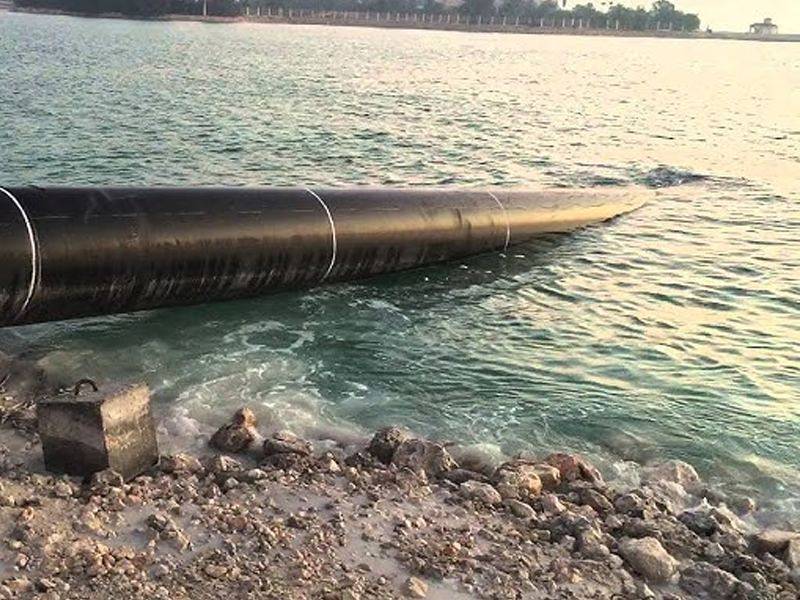
Drilled Crossings and Submerged Sections
River crossings, road bores and anything below the water table are the conditions this coating was developed against. A directional drill pulls the film through soil under tension for hundreds of metres, and a submerged section never dries out. These conditions may require dual-layer FBE, an abrasion-resistant overcoat or another mechanically reinforced system, depending on the project specification.
External FBE Coating Cost
Charging runs per square metre of coated surface, with 200 square metres as the minimum order and around 7 days as a typical job length. No single external FBE coating price exists, because two identical square metres price apart once diameter and specification are known. Four variables move a quotation:
- Pipe outside diameter and the total coated area
- Film thickness and the standard your document names
- Coating system, since dual layer FBE and an abrasion resistant overcoat each add material and passes
- Component mix, since a square metre of flange or bend absorbs more handling than a square metre of plain barrel
Get Best Price for Your Pipe Schedule. For quotation, provide the complete pipe schedule and coating specification so the scope can be evaluated against the project requirements.
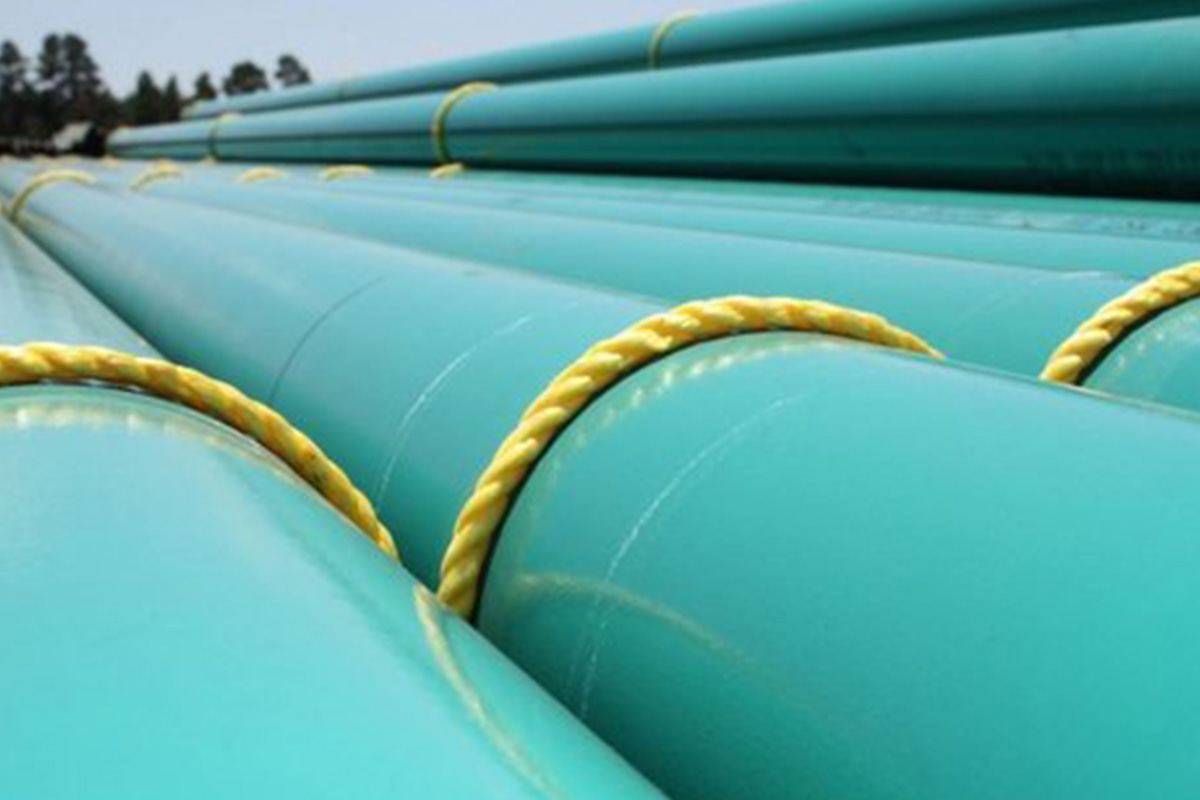
Why Choose Radisson Impex for External FBE Coating
Three reasons to place external FBE work with us, and the same shop handles the rest of our pipe coating scope.
- Bends, fittings and flanges get the same epoxy film as plain pipe, since a manual station isn't tied to a fixed line profile.
- Film thickness, blast grade and the test regime all come from your project document, not from a house standard we ask you to adopt.
- Every job closes with certificates and a coating report covering DFT, holiday, adhesion, cure and cathodic disbondment, and third-party inspection can be built into that.
External FBE Coating: Frequently Asked Questions
What is the full form of FBE Coating?
FBE stands for Fusion Bonded Epoxy: a thermosetting powder applied to pre-heated steel that melts, cross-links, and cures into a tough protective film. External applications are often designated as EFBE or FBEC in pipeline tenders.
What type of coating is External FBE?
External FBE is a 100% solid thermosetting powder coating rather than a conventional paint. Because the cross-linking reaction cannot be reversed, cured FBE will not melt or flow again when reheated. Each powder does have a maximum service temperature linked to its glass transition temperature, so the powder is selected for the line's operating temperature.
What is the External FBE Coating application process?
Pipes are blast-cleaned to Sa 2½ with the specified surface profile, preheated, electrostatically sprayed with dry epoxy powder, then left to fuse and cure before water quenching and holiday testing.
Which pipe types and materials can you coat with External FBE?
We coat Seamless Pipe, ERW Pipe, LSAW Pipe, and HSAW Spiral Welded Pipe across carbon steel, LTCS, and alloy steel grades. Capacity spans 1" to 200" OD for straight pipe, bends, fittings and flanges.
What is the difference between External and Internal FBE Coating?
External FBE Coating shields buried and submerged lines against corrosive soils, moisture, and cathodic disbondment. Internal FBE Coating lines the pipe bore to protect against harsh process fluids and significantly reduce pumping friction.
How is External FBE Coating removed?
Cured FBE does not melt, so it cannot simply be softened and wiped off. It is removed by controlled heating and scraping, abrasive blasting, or both, taking care to limit steel loss from the pipe surface.
What External FBE Coating thickness do you apply?
Coating thickness is applied to the figure in your engineering specification. Every finished length is checked with calibrated magnetic dry film thickness (DFT) gauges.
Which External FBE Coating standards do you work to?
We apply coatings under major pipeline standards including ISO 21809-2, NACE SP0394, CSA Z245.20, and AWWA C213, with full inspection reports and material batch certificates supplied for your records. The first three are written for plant-applied coating, and AWWA C213 covers steel water pipe and fittings.
Contact Us for Your Coating Requirement. Send the pipe schedule and coating specification, and we'll confirm scope and testing.